At my husband’s funeral, a little girl I had never seen whispered that he had promised I would take care of her. Then she handed me a videotape with his handwriting on it, and everything I thought I knew about our quiet, childless marriage began to unravel.
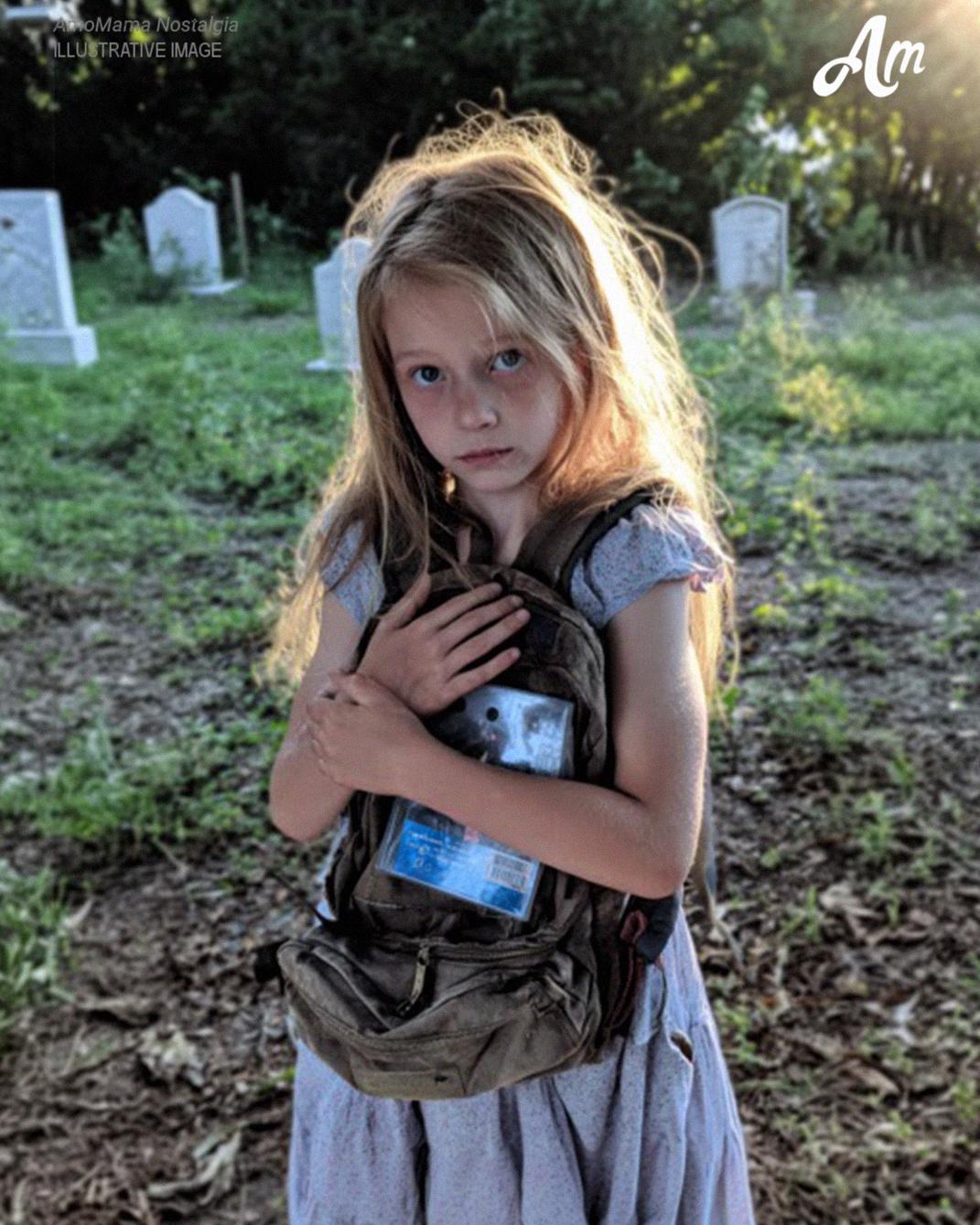
The first time I saw Matilda, she was standing beside my husband’s casket with rainwater dripping from the ends of her braids, clutching a faded purple backpack like it was the only thing keeping her upright.
Morgan had disappeared twenty minutes earlier, saying she needed to check on the food at the house.
Most people had already drifted away from me by then.
They had hugged me, murmured the usual things, and moved toward the chapel doors with their black coats and careful faces.
But this little girl came closer.
They had hugged me.
“Mrs. Camille?”
I turned with the damp tissue my best friend, Morgan, had pressed into my palm. “Yes, sweetheart? Do I know you?”
She shook her head.
Then she said the sentence that made the whole funeral tilt under my feet.
“Your husband told me you’d take care of me.”
“Mrs. Camille?”
***
Atlas and I had been married for twelve years. For ten of them, we had lived with quiet grief after his car accident left him unable to have children.
We had cried, packed away the yellow nursery curtains, and learned how to build a life around an empty room.
Or so I thought.
***
“I’m sorry,” I said carefully. “Who are you?”
“My name is Matilda.”
“Matilda,” I repeated. “How did you know my husband?”
“My name is Matilda.”
Her fingers tightened around the backpack straps. “He said you might be angry first.”
My throat went dry. “Why would I be angry?”
“Because he was scared this would hurt you.”
Before I could answer, she unzipped her backpack and pulled out an old videotape sealed in plastic. A white label crossed the front.
“For Camille.”
It was in Atlas’s handwriting.
My knees weakened. “What is this?”
“Why would I be angry?”
“He said you had to watch it at home. He said you’d understand everything.”
“Who brought you here, sweetheart?”
Matilda glanced toward the rainy parking lot.
I followed her eyes and saw Morgan standing under a black umbrella, one hand pressed over her mouth.
My best friend. The woman who had sat beside me in the front row and held my hand while they carried Atlas in.
The woman who, apparently, knew exactly why a child had come to my husband’s funeral with a tape.
“Morgan?” I whispered.
“He said you’d understand everything.”
Matilda’s voice shook. “Please don’t be mad at her. Mr. Atlas asked her.”
Mr. Atlas.
Not Dad. Not father.
Still, my heart pounded.
Matilda pushed the tape into my hands. “He said you’d understand once you saw it. But don’t wait, okay? If you wait, it might be too late.”
“Too late for what, Matilda?”
My heart pounded.
She looked down. “For me to believe him.”
Then she walked back into the rain.
I didn’t chase her. I just stood there holding my dead husband’s secret while Morgan helped the little girl into her car.
***
At home, I didn’t change out of my black dress. I didn’t eat any of the food laid out downstairs. I just locked myself in my bedroom with the tape on the bed.
I stared at it until Morgan called for the sixth time.
She walked back into the rain.
I let it ring.
Then I dragged out the old VCR, hooked it up with shaking hands, and pressed play.
The screen flickered blue.
***
He was sitting in his workshop behind our garage, wearing his green sweater with the stretched cuff. His face looked thinner, or maybe I had refused to see it.
“Camille,” he said, looking straight into the camera. “Before you get angry, remember one thing. I never hid this because I didn’t trust you. I hid it because I loved you too much to make you grieve the life we never had all over again.”
The screen flickered blue.
I covered my mouth.
“Her name is Matilda,” he continued. “She lives at Willow House, a group home not too far from us. Morgan volunteers there on Sundays. She once mentioned they needed readers, so I went. Then I went again. Somehow, Sunday became the only day I stopped feeling useless.”
“No,” I whispered.
“I know what you may think,” Atlas said. “But Matilda isn’t my daughter. I was never unfaithful to you, my love. I never wanted another life.”
“Sunday became the only day I stopped feeling useless.”
My shoulders folded.
“But I did lie. Every time I said I was taking a long walk, I was going to Willow House. I told myself I was protecting you. Maybe I was protecting myself too.”
On the screen, he rubbed his forehead. He always did that when he hated what he had to say.
“Matilda was six when I met her. She beat me at checkers and called me slow to my face. I loved her immediately.”
“But I did lie.”
A laugh broke out of me, then turned into a sob.
“She’s had too many adults leave, Cami,” he said. “So I made a promise I shouldn’t have made alone. I told her that if I couldn’t come anymore, my wife would know what to do.”
I stood so fast the TV remote fell. “Atlas, no.”
“I’m not asking you to be her mother,” he said. “I’m asking you to meet her. Melissa at Willow House knows everything. Morgan knows how to get there. Be angry with me. You have every right. But not them. Please don’t let my cowardice become one more adult disappearing from Matilda’s life.”
“She’s had too many adults leave.”
The tape crackled.
Then my husband leaned closer.
“You once told me you married me, not a future. I believed you. But I never told you that I still mourned being needed by a child. You were enough, Camille. You were always enough. I just had this room in my heart I didn’t know how to close.”
He swallowed.
“If there’s any good left in the secret I kept, it’s her.”
The tape ended.
“You were enough, Camille.”
***
For a while, I sat in the blue light with Atlas’s empty side of the bed beside me and his reading glasses still on the nightstand.
Then I called Morgan.
She answered on the first ring.
“You watched it,” she said.
“How long, Morgan?”
She didn’t pretend to misunderstand. That hurt almost as much as the answer.
I called Morgan.
“Two years,” Morgan said.
I gripped the phone. “Two years? Are you kidding me?”
“Camille…”
“How could you keep this from me?”
She went quiet.
“You sat beside me last Mother’s Day,” I said. “You brought muffins. You watched me pack away the yellow curtains and pretend they were just ugly. All this time, you knew my husband was healing his heart with a little girl?”
“Are you kidding me?”
Morgan’s breath shook. “I knew he was reading at Willow House. I knew about the checkers games and the books. I didn’t know he’d promised Matilda anything until near the end.”
“But you knew there was a Matilda.”
“Yes.”
“You should have told me.”
“I know.”
“That’s it?”
“You should have told me.”
“No,” she whispered. “That’s just the only part I can say without turning it into an excuse.”
I pressed my fingers to my eyes. “Did you bring her today?”
“She begged to say goodbye.”
“That wasn’t my question.”
“Yes, Camille,” Morgan said. “I brought her.”
My laugh came out sharp.
“Atlas left me a note,” she said quickly. “He said if he ran out of time, I had to make sure you got the tape. I told Matilda the funeral might be too much.”
“She begged to say goodbye.”
“For her?” I asked. “Or for me?”
“Both.”
“You let me stand there feeling insane, Morgan.”
“I thought if I told you first, you would never watch it.”
“Maybe I deserved that choice.”
“You did,” she said. “I’m sorry.”
I wanted to hang up. Instead, I forced myself to breathe.
“Pick me up in the morning.”
“I’m sorry.”
“You want me to come? Really?”
“I want the truth from someone who isn’t dead and apologizing through a television. You can drive me to Willow House. After that, you can explain exactly how my best friend ended up standing between me and my own marriage.”
***
Willow House was a wide brick home with blue shutters, muddy bikes by the porch, and paper suns in the windows.
Inside, it smelled like buttered toast and floor cleaner.
Melissa met us near the office, wearing a navy cardigan. She had gray in her curls and a calm face I wanted to trust and resent at the same time.
“I want the truth.”
“You must be Camille,” she said.
I stiffened. “Apparently, everyone knows me.”
“No,” Melissa said gently. “Atlas talked about you. This is different.”
“Then talk to me,” I said. “No soft version. No protecting my heart. Tell me everything.”
She led me into a small reading room. An armchair sat by the window. A chessboard waited on the table. Beside it was a mug that read “World’s Okayest Volunteer.”
“Atlas talked about you. This is different.”
Atlas would have loved that stupid mug.
“That was his chair,” Melissa said. “Every Sunday, Matilda saved it for him.”
***
I touched the back of Atlas’s chair. “He came every Sunday?”
“Every Sunday,” Melissa said. “Storms, holidays, even after treatments. Once, he had a fever, and I threatened to call you myself.”
“Why didn’t you?”
“Because he begged me not to.”
“He came every Sunday?”
My anger sharpened. “Everyone keeps saying that like my heart was a vase on a shelf.”
Melissa nodded. “I never thought it was fair to you.”
A small voice came from the doorway.
“Mrs. Camille?”
Matilda stood there with her backpack zipped tight.
I crouched. “Hi, Matilda.”
She studied me. “Are you still angry?”
My anger sharpened.
“Yes,” I confessed. “But not at you, sweetheart.”
“Mr. Atlas said you alphabetize your spice jars.”
I laughed through the ache.
“I do,” I said. “And he was always messing them up.”
Before Matilda could say anything, Melissa touched my shoulder. “Camille, if you choose to be part of Matilda’s life, we do it properly. Background checks, home visits, court approval. Nothing happens because Atlas asked nicely from a tape.”
Melissa touched my shoulder.
“Good,” I said, looking at Matilda. “Then nobody gets another promise that breaks.”
Matilda’s chin trembled. “Does that mean you’re leaving?”
“No,” I said. “It means if I stay, I stay the right way, sweetheart.”
***
Later that week, Atlas’s family held a memorial lunch. I went so no one else could tell the story for me.
His cousin Bethany cornered me near the coffee urn. “So it’s true? Atlas had some secret child?”
“Matilda isn’t his child.”
“But he played father to her while you sat home alone?”
“Does that mean you’re leaving?”
The patio went quiet.
Morgan stepped forward. “Bethany, don’t.”
“You don’t get to speak,” Bethany snapped. “You helped hide it.”
Morgan went pale. “I should have told Camille. I’ll carry that forever. But don’t make what Atlas did sound dirty because you don’t understand it.”
I looked at Bethany. “My husband hurt me, sure. He lied, yes. But he didn’t betray me with Matilda. He loved a lonely child because the loudest grief in our marriage was the one we stopped naming. If any of you turn her into gossip, you will answer to me.”
No one spoke.
“You helped hide it.”
***
Three weeks later, after fingerprints, interviews, and one panic-cleaned home visit, I became Matilda’s approved weekend foster placement.
That Sunday, she had a small program at Willow House. There was one empty chair in front.
“Atlas always sat there,” Melissa whispered.
I sat down.
Matilda froze onstage when she saw me. I lifted Atlas’s green scarf and mouthed, “I’m here.”
She finished every line.
“Atlas always sat there.”
Afterward, she walked into my arms carefully, like trust was something she was still learning how to carry.
Morgan found me after the program and stopped a few feet away, like she no longer assumed she had the right to stand close.
“I’m still angry,” I told her.
She nodded. “I know.”
“But you showed up today.”
“I’ll keep doing that,” she said.
For now, that was enough.
“I’m still angry.”
***
Months later, Willow House renamed the reading room after Atlas.
Melissa invited the children, the volunteers, Morgan, and the family members who had run out of cruel questions. Bethany stood in the back, silent for once.
When Melissa pulled the cloth from the small brass plaque, Matilda slipped her hand into mine.
“He said you’d come,” she whispered.
Matilda slipped her hand into mine.
I looked at Atlas’s name on the door, then at the child he had loved quietly when no one was watching.
“He was right,” I said.
I had gone to Willow House looking for the part of my husband he had hidden from me.
I left holding the hand of the part he had trusted me to love.