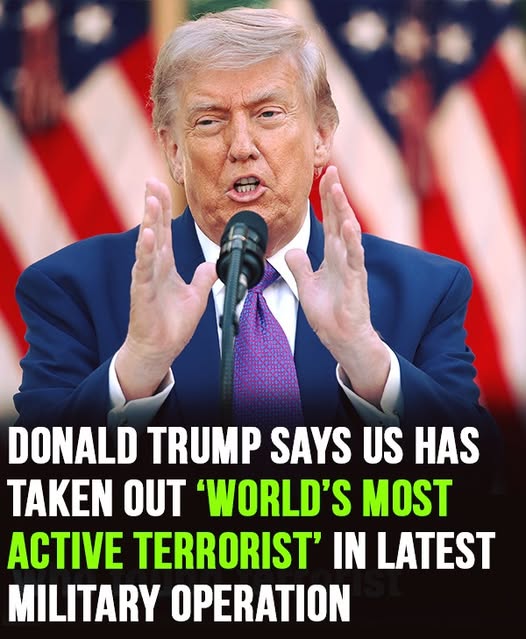
President Donald Trump recently announced that American and Nigerian forces carried out a joint military operation targeting a senior leader connected to the Islamic State group in West Africa. According to statements released through official channels and later reported by major international media organizations, the operation focused on Abu-Bilal al-Minuki, also referred to in some reports as Abu Bakr al-Mainuki. Trump described him as a high-ranking ISIS figure and claimed the mission represented a major counterterrorism success in the region.
The announcement quickly drew international attention because it highlighted the growing security cooperation between the United States and Nigeria. Counterterrorism efforts in West Africa have intensified over recent years due to the expansion of extremist groups linked to ISIS and other militant organizations operating across the Sahel and Lake Chad Basin regions. These areas, which include parts of Nigeria, Chad, Niger, and Cameroon, have experienced prolonged instability caused by insurgent violence, kidnappings, and attacks on both civilians and security forces.
According to reports from international news agencies, the operation was the result of months of intelligence gathering and surveillance. Officials indicated that the targeted compound was located within the Lake Chad Basin region, an area that has long served as a strategic base for extremist groups because of its difficult terrain, remote waterways, and porous borders. Military analysts have often described this region as challenging for counterterrorism operations due to the ease with which armed groups can move between countries and avoid detection.

Trump stated that the operation was “meticulously planned” and praised the coordination between U.S. forces and the Nigerian military. Nigerian authorities also confirmed that the mission had been successful and reported that no American or Nigerian troops were injured during the operation. Officials described the strike as an example of increasing military collaboration between the two countries, particularly in intelligence-sharing, aerial surveillance, and tactical coordination.
Abu-Bilal al-Minuki had previously been designated by the United States government as a Specially Designated Global Terrorist. Reports from U.S. agencies linked him to ISIS operations in West Africa and the Sahel region, where extremist organizations have expanded significantly since the collapse of ISIS territorial control in Iraq and Syria several years ago. Analysts have noted that as ISIS lost ground in the Middle East, many affiliated groups strengthened their presence across parts of Africa, where weak border control and regional instability created opportunities for expansion.
The rise of ISIS-affiliated organizations in Africa has become a growing concern for international security experts. Groups operating in West Africa have been linked to attacks on villages, military installations, transportation routes, and humanitarian operations. These organizations often attempt to exploit local conflicts, economic hardship, and limited state control in rural areas to recruit members and establish influence. As a result, regional governments have increasingly relied on international partnerships to strengthen counterterrorism capabilities.
Nigeria has faced extremist violence for more than a decade, particularly in its northeastern regions. Multiple armed groups, including factions connected to Boko Haram and ISIS-West Africa Province, have carried out attacks that displaced communities and created ongoing humanitarian challenges. Nigerian security forces have conducted numerous military campaigns over the years, though the conflict has remained complex due to the geographic scale of the region and the adaptability of insurgent groups.
Military experts note that eliminating high-ranking leaders can disrupt extremist operations temporarily by weakening command structures and communication networks. However, they also caution that long-term success depends on broader strategies that include regional cooperation, economic development, intelligence operations, and community stabilization. Counterterrorism efforts are generally considered most effective when military action is combined with efforts to address the underlying conditions that allow extremist groups to recruit and operate.
The operation also reflects a broader shift in global counterterrorism priorities. In recent years, Africa has become an increasingly important focus for international security agencies because extremist activity has expanded across several regions of the continent. Reports from international organizations have indicated that a large percentage of recent ISIS-related incidents globally have occurred in Africa, particularly within the Sahel and West African regions. This trend has led countries such as the United States to increase intelligence and military cooperation with regional governments.
Media coverage of the operation varied widely, with some outlets focusing on the military significance while others emphasized the geopolitical implications. Social media discussions also reflected a mixture of reactions, including support for the operation, debates over international military involvement, and broader conversations about terrorism and regional stability. As with many high-profile military announcements, online commentary often included both verified information and speculative interpretations, highlighting the importance of relying on credible sources for accurate reporting.
Counterterrorism analysts have pointed out that operations targeting senior extremist figures are often intended not only to reduce immediate threats but also to disrupt propaganda, financing, and recruitment networks. High-ranking leaders within ISIS-affiliated organizations frequently oversee strategic planning, funding coordination, and communication between regional branches. Removing such individuals can therefore create operational challenges for militant groups, even if the broader movement continues to exist.
The Nigerian government described the mission as evidence of strengthened cooperation with international allies. Security partnerships between Nigeria and the United States have evolved over time, particularly in areas such as intelligence support, military training, surveillance technology, and logistical coordination. Officials from both countries have emphasized that joint efforts remain important in responding to cross-border extremist threats affecting West Africa.
Despite the reported success of the operation, experts caution that extremist organizations often attempt to reorganize after leadership losses. Militant groups may appoint new commanders, shift operational areas, or intensify propaganda efforts in response to military pressure. Because of this, counterterrorism strategies generally require sustained international cooperation and long-term regional stability efforts rather than reliance on isolated operations alone.
In conclusion, the reported operation involving U.S. and Nigerian forces represents a significant development in ongoing counterterrorism efforts in West Africa. According to official statements, the mission targeted a senior ISIS-affiliated figure believed to have played a major role in regional extremist operations. While military officials described the strike as a major success, analysts emphasize that the broader fight against extremist violence in Africa remains complex and ongoing. The operation also highlights the increasing importance of international partnerships, intelligence cooperation, and regional security coordination in addressing evolving global terrorism threats.