The ride home was supposed to be just another crowded, miserable commute until one frustrated passenger snapped at an elderly man for playing music out loud — and uncovered the painful life he had been trying to hold together in silence.
I was the woman who snapped at the old man on the train.
I wish I could tell you I was patient first. That I gave him a kind smile, or asked politely, or at least tried to act like the sort of person I always imagined I was.
I did not.
It was a Thursday. Rainy and freezing. I was exhausted and angry.
I was stuck in a kind of ugly evening commute where everyone’s coat smells damp, and the train windows look like the city is trying to disappear.
I had just finished a brutal 10-hour shift at the after-school center I run.
Half my staff was out sick, one parent accused us of “crushing creativity” because we would not let her son throw markers at the ceiling, and my landlord had texted me that my rent was going up again.
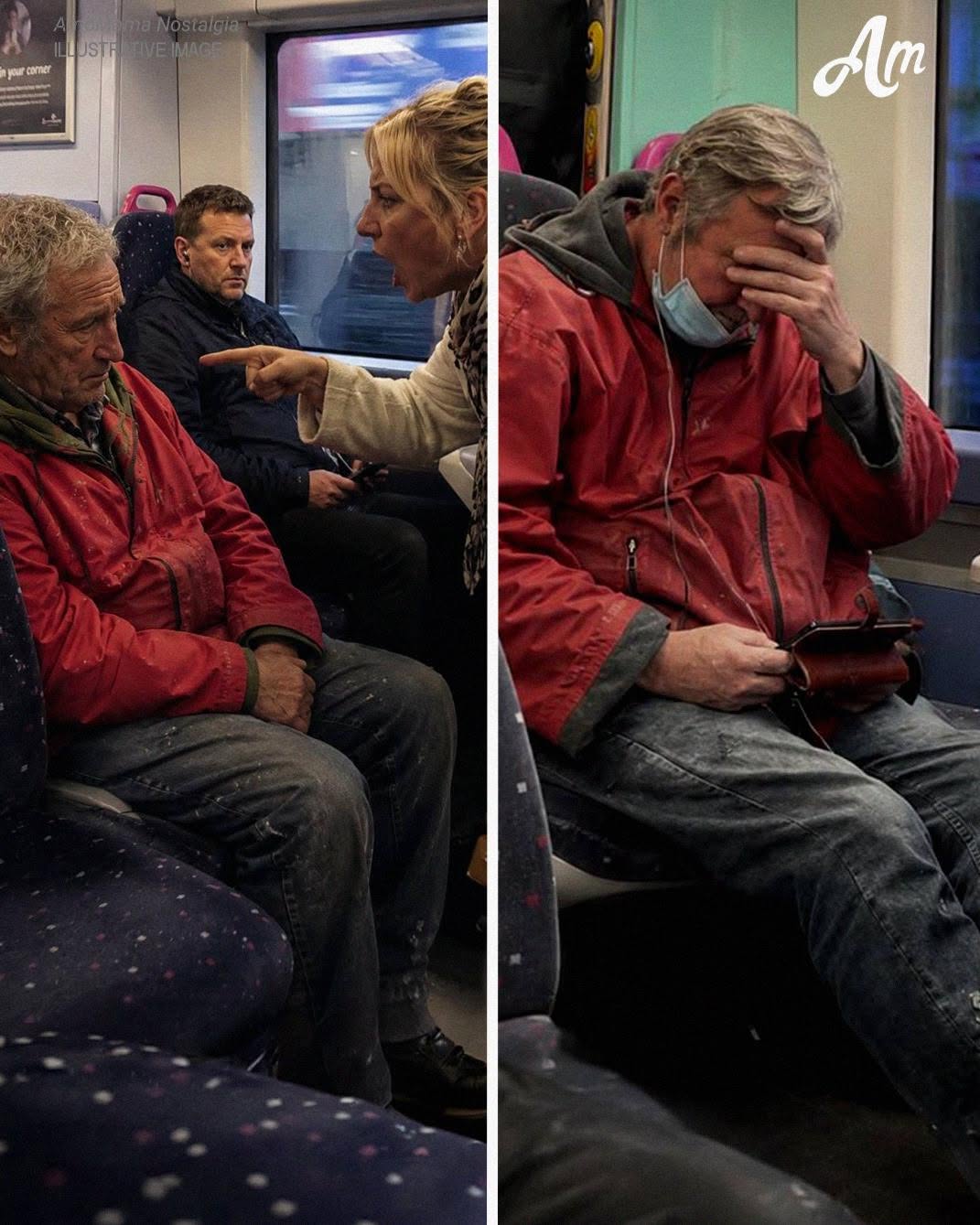
So when the old man across from me started playing music out loud from his phone, something in me just broke.
It was not even loud in a wild way. It was old music, tinny and scratchy through a cheap phone speaker. Some slow song with violins and a man’s voice that sounded like it had been recorded in another century.
Still, on a packed train after work, it felt like an act of war.
People started doing what people always do in public when they are annoyed, and hoping someone else will take the social risk. They sighed, shifted, and glanced at each other.
The old man either did not notice or pretended not to.
He sat by the window in a worn brown coat, one hand holding his phone, the other clutching a pair of old wired headphones. The cable was bent in three places and wrapped in strips of yellowing tape.
Every few seconds, he fiddled with the wire, frowned, and then the music crackled again through the speaker.
By the fifth minute, I was done.
“Bruuh, we’re in public,” I said, louder than I meant to. “Not everyone wants to listen to your music after work.”
The whole train went quiet in that ugly, alert way it does when conflict finally arrives.
The old man looked up at me immediately. He could not have been younger than 70. Maybe older. He had a tired face, deep lines around his mouth, and the kind of eyes that already look apologetic before anyone says a word.
He fumbled with the screen and lowered the volume.
“I’m sorry,” he said softly. “I’m sorry.”
I should have left it there. Instead, because I was still angry, embarrassed, and now had an audience, I crossed my arms and said, “Then maybe use headphones like everyone else.”
He looked down at the headphones in his hands, and for a second, he just stared at them.
“They stopped working properly,” he said. “I have to keep adjusting the wire every few seconds.”
The tape on the cable was peeling.
One earbud was missing its rubber tip. The whole thing looked older than some of the kids at my center.
I rolled my eyes.
I hate admitting that, but I did.
The old man saw it. Of course he did.
Then he added, even more quietly, “I just didn’t want to fall asleep and miss my stop.”
Something about the way he said it changed the air in the train.
He gave this little, embarrassed smile and lifted one shoulder. “It’s a long ride.”
The train rattled on. Somebody at the far end coughed. A teenager who had been smirking a second ago suddenly looked down at his shoes.
I do not know what made me ask the next question. Guilt, maybe. Or the fact that he looked less like an inconsiderate stranger now and more like someone barely keeping himself upright.
“How long?” I asked.
He glanced at me, surprised I was still talking to him.
“Two hours,” he said. “Sometimes a little more if I miss the transfer.”
“Every day?”
He nodded.
“Why?”
He looked at the phone in his lap as if deciding how much of his life a train full of strangers deserved.
Then he said, “Because it is the only job I could keep.”
That got everyone’s attention differently.
He must have felt it, because he let out a small breath and went on.
“My daughter died last year,” he said. “Vivian. She got sick very fast. By the time the doctors understood what they were dealing with…” He shook his head once. “It was already too late.”
The train was silent now.
He swallowed and kept going.
“She had a little girl. Zahara. She’s seven.” He smiled then, but it was the most tired smile I had ever seen. “So now it is just her and me.”
My throat tightened.
He said it so simply. No performance or a plea for sympathy.
“The house we live in belonged to my wife,” he said. “She passed years ago. It is old and far outside the city, and honestly, half of it is falling apart. But it is free. That matters.”
Someone across the aisle asked, very gently, “You commute from there every day?”
He nodded. “I work in maintenance at a school building in the city. The hours are flexible. They let me leave if I have to.”
His fingers tightened around the broken headphones.
“Sometimes I need to go suddenly if Zahara is alone, sick, or scared. Most jobs did not like that.” He gave another tired little smile. “Most jobs fired me because of that.”
No one even pretended to check their phone anymore.
He looked out the window for a moment, then back down at his hands.
“She still thinks her grandpa can fix everything,” he said.
That did it.
I felt my face burn so hot I wanted the train to swallow me whole.
A woman near the door wiped at her eyes. The teenage boy who had been smirking earlier looked like he was trying very hard not to cry in front of strangers. Even the businessman with expensive headphones had gone completely still.
I moved without thinking and sat down beside the old man.
“I’m sorry,” I said quietly. “I shouldn’t have spoken to you like that. I’ve just had a stressful day too.”
He nodded right away, almost too fast, like he was used to making room for other people’s bad moments.
“It’s all right.”
“No,” I said. “It isn’t.”
Up close, I could see how exhausted he really was. His cuffs were frayed. His hands were rough and dry with deep cracks across the knuckles. There was paint on one sleeve of his coat. White, maybe from some school hallway he’d patched earlier.
“What’s your name?” I asked.
“David.”
“I’m Nia,” I said.
He nodded once. “Nice to meet you, Nia.”
It was such a polite thing to say in the middle of that moment that I nearly lost it.
Instead, I asked, “How old did you say Zahara was again?”
“Seven.”
That number hit me harder than it should have.
Most of the kids at my center were between six and ten. I knew their backpacks, their missing teeth, their weird obsessions with dinosaurs, stickers, or one specific cartoon they all somehow discovered at once. I knew what seven looked like.
Seven meant needing snack reminders, help with shoelaces, and still believing an adult could stand between you and anything bad.
“Who watches her after school?” I asked.
David hesitated. “A neighbor checks in sometimes. But she is older, too. I try to get home as fast as I can.”
“And during school breaks?”
“I use all the time off I can. Or I bring her to work if they allow it. Sometimes they do. Sometimes not.”
He said it carefully, but I could hear the strain underneath. The constant calculation and tiredness. The kind single caregivers do when one misses a shift can have the whole structure collapse.
I thought about Zahara in some cold old house at the far end of a train line, waiting for footsteps on the porch every evening.
Then I reached into my bag.
I always carry a stack of cards for the center because I am always recruiting, apologizing, explaining, fundraising, networking, or trying not to sink.
I took one out and placed it carefully into David’s hands.
He looked down at it, confused.
“I run an after-school center for children,” I said. “Bring Zahara tomorrow morning. Don’t worry about the payment.”
He stared at the card for a long time.
I could see the words hitting him one by one, almost like he did not trust them to stay real. Bright Futures Learning Center. My name, number, and address.
“I’m serious,” I said. “We open at 7:30 a.m. We have scholarship spots. We do homework help, meals, and transport for some neighborhoods. If I can’t get her picked up right away, I’ll figure something else out.”
David’s mouth opened slightly, but no sound came out.
“She shouldn’t be alone that much,” I said more gently. “And you shouldn’t have to do all of this by yourself.”
That was when he broke.
He pressed the heel of his hand to his mouth, bent forward, and started crying.
The kind of crying a person does when they have held too much for too long, and one small kindness cuts the rope.
The entire train stayed silent.
Nobody looked away either. That was the strange thing.
Usually, when a stranger cries in public, people perform this awkward ritual of giving privacy by pretending not to see.
Not that night.
That night, everyone saw him.
One woman took tissues from her purse and passed them down the row. The teenage boy offered David the unopened bottle of water from his backpack.
The businessman with the expensive headphones pulled out a phone charger and said, “My stop is three away, but take this anyway. I have extras.”
David kept trying to say thank you, but the words kept breaking apart.
I put a hand lightly on his shoulder. “It’s okay,” I said, though obviously it was not. “You don’t have to say anything right now.”
He looked at me with red, stunned eyes. “You don’t know us.”
“Not yet.”
That made him laugh once through the tears.
The woman with the tissues asked, “How old is Zahara again?”
“Seven,” he said.
She nodded and opened her tote bag. “My granddaughter outgrew half her winter things. I can drop some off somewhere if that helps.”
Then the teenage boy, who could not have been older than 16, muttered, “My little sister has books she doesn’t read anymore. Girl books, I mean. Like, chapter books.” He was red in the face by the end of it. “I could bring those.”
The businessman said, “My wife works for a legal aid office. They help with guardianship paperwork and housing issues sometimes. If you need that, I can write down her info.”
One act of kindness turned into five. Then 10.
A woman near the doors offered grocery gift cards. Another passenger said his cousin fixed old boilers and might be willing to look at the heating system in the house.
Someone else offered a decent pair of wireless headphones right off his neck.
The train felt less like public transit and more like a room where people had suddenly remembered they were human.
David kept looking around like he could not understand why any of this was happening to him.
Then he said something that I still think about.
“I wasn’t trying to bother anyone,” he said. “I just knew if I fell asleep, Zahara would be waiting in the dark.”
Nobody spoke after that. There was nothing to add.
When the train reached his transfer stop, I stood up with him.
“So tomorrow,” I said. “At 7:30 a.m. Bring Zahara.”
He nodded hard. “I will.”
“Do you have breakfast figured out in the mornings?”
He hesitated.
That was enough of an answer.
“We’ll feed her.”
His eyes filled again.
As the doors opened, he turned back to me. “Vivian used to say strangers are only strangers for one minute too long.”
I smiled, even though my throat was tight. “She sounds smart.”
“She was.”
Then he stepped onto the platform carrying my card, the tissues, a borrowed charger, a pair of newer headphones, and three phone numbers scribbled on the back of receipts by people who had started the ride irritated and ended it invested.
The next morning, David came to the center with Zahara.
She had two tight braids, a coat one size too small, and the exact guarded expression of a child trying to be brave because she suspects the adults around her need help holding it together.
David looked terrified, bringing her in.
Zahara did not.
She took one look at the art corner, the shelves of books, the half-built cardboard castle in the reading area, and asked, “Can I stay here after school too?”
I laughed. “That’s kind of the whole idea.”
She considered me for a second and then nodded like she approved.
David almost cried again before he left for work.
That was eight months ago.
Zahara still comes every day.
We found a donor to cover her place for the year. The businessman’s wife really did connect David to legal aid. The boiler got fixed by somebody’s cousin for the cost of parts.
The teenage boy brought in two grocery bags of books and acted embarrassed the entire time. The woman with the tissues sent three coats, boots, and enough gloves to outfit a small army.
And David?
He still takes the train home every night.
But now he wears proper headphones, wireless ones. Bright blue, because Zahara picked them out and said old people deserve fun colors too.
Every once in a while, when the center is quiet and the kids are working on homework, I think about how close I came to carrying that day differently.
I could have stayed angry.
I could have gone home and told the story about an inconsiderate old man blasting music on public transit.
Instead, I got the truth.
Now, whenever Zahara runs into the center yelling, “Miss Nia, Grandpa said the soup didn’t burn this time,” or David shows up with a repaired toy shelf because he noticed it wobbling last week, I remember that whole train going silent around one tired man and his broken headphones.
People were furious at him for playing music out loud.
I was the loudest one.
And I was also the one who got to learn that sometimes what looks like rudeness is really just survival held together with tape, exhaustion, and one old song keeping a man awake long enough to get home to the child waiting for him.
But here is the real question: When what looks like selfishness is really survival, how do you forgive yourself for the moment you assumed the worst?
If you enjoyed this story, you may love this next one: My 12-year-old son came home soaked after giving away his late father’s umbrella to a pregnant stranger in the rain. I wanted to be angry until the next morning, when our lawn was covered with 47 umbrellas and boxes that turned his quiet kindness into something much bigger.