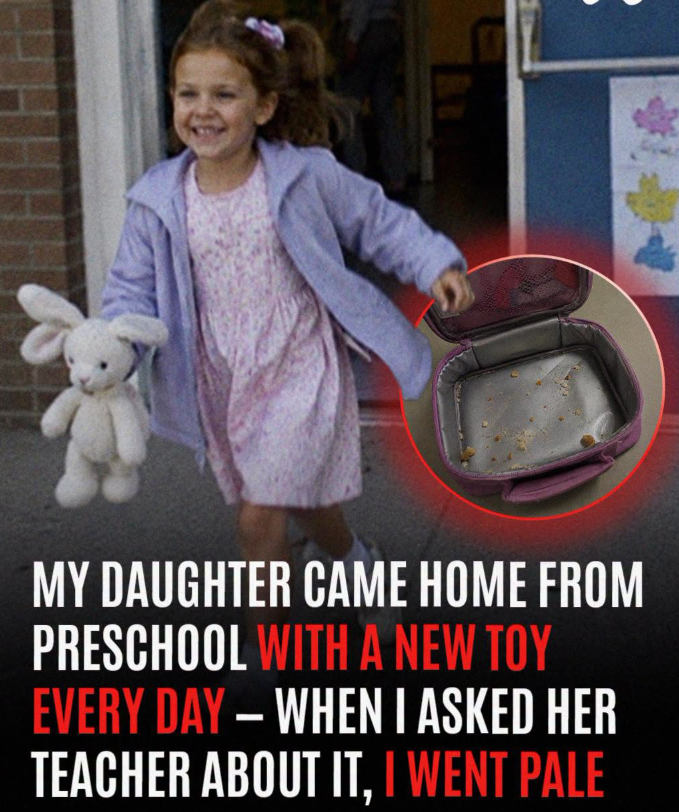
My 4-year-old daughter started coming home from preschool with a new toy almost every day: a stuffed bunny, a doll, a music box. I thought she was taking things that didn’t belong to her. I was not prepared for the truth.
I’m 31, a single mom, and my daughter Lily is 4.
She started preschool this fall, and I was trying very hard to be one of those mothers who look calm in the parking lot and then quietly fall apart in the car after drop-off.
I work full-time at a dental office.
My hours are long, my mornings are chaos, and most days I feel like I’m losing a race nobody explained to me. But I always pack Lily’s lunch myself. That’s one thing I don’t hand off, don’t forget, don’t rush through more than I have to.
Every morning, it’s the same routine. Turkey sandwich cut into squares because she says triangles taste “too pointy.” Apple slices. Crackers. A yogurt tube. Sometimes, a little treat if I know she had a hard day before. I zip the lunchbox, kiss the top of her head, and tell myself that even if the rest of life feels patched together, at least I got that part right.
Then the toys started showing up.
The first one was a stuffed bunny with one bent ear and a pink ribbon around its neck. I noticed it when I buckled Lily into her car seat after pickup.
“Where did you get that?” I asked.
She smiled down at it like it had told her a secret.
“A friend gave it to me.”
I assumed it was a class prize or maybe something from a treasure box. Preschool teachers are always pulling out stickers, tiny plastic rings, and pencils shaped like animals. I didn’t think much of it.
Then the next day, she came home with a little red toy car. The day after that, a doll in a faded yellow dress. Then a small puzzle in a dented box. Then another stuffed animal. Then a wooden music toy with chipped paint on the corners.
It became a pattern. Every day at pickup, Lily came out holding something new.
Some of it was obviously old, the kind of old that says a child loved this once. Some of it looked expensive. Not brand-new expensive. More like well-made, carefully chosen, meaningful.
That’s what started bothering me. Because there’s a difference between junk-bin toys and things somebody once cared about.
I asked Lily again one night while she was sitting cross-legged on the living room rug, lining everything up in a neat row.
“Baby, who keeps giving you these?”
“A friend.”
“What friend?”
She shrugged. “My friend at school.”
“Is it a little girl? A little boy?”
She thought about that, then said, “No.”
I stared at her. “Then who?”
She looked up at me with those serious brown eyes and said, “Someone who gets happy when I talk to them.”
That answer did not help. For the next week, I kept asking in different ways, hoping I’d catch her in a more specific mood.
“Did a teacher give you the doll?”
“No.”
“Did you ask for the puzzle?”
“No.”
“Did you take it from the classroom?”
Her whole face changed at that. Not guilty. Hurt.
“I don’t take things,” she said quietly.
I felt awful right away. “I know, honey. I just need to understand.”
She hugged the bent-ear bunny to her chest and said, “It was a gift.”
That should have reassured me, but it didn’t. Because Lily is sweet, but she’s also 4. Four-year-olds think the world belongs to whoever touched it last. A “gift” could mean anything.
I finally hit my limit when she brought home a white music box with tiny painted flowers on top. It played a soft little tune when I wound it, and I just stood there in the kitchen listening to it, feeling uneasy.
No preschool was handing that out.
The next morning at drop-off, I asked Lily’s teacher if we could talk.
Ms. Alvarez stepped into the hallway with me. She was the kind of teacher who remembered every parent’s work schedule and every child’s favorite snack. Warm, calm, impossible to rattle.
I held up the music box.
“I wanted to ask about the toy rewards.”
She blinked. “The what?”
“The toys Lily has been bringing home. I thought maybe they were prizes.”
Her expression changed immediately.
“We don’t give out toys,” she said.
Something in my stomach tightened.
“At all?”
She shook her head. “No. Definitely not.”
I lowered my voice. “Then where are they coming from?”
She glanced toward the classroom door, then back at me. “Let me look into it today.”
I nodded, but I left with that sick feeling in my chest mothers get before they know whether they’re dealing with something small or something that is about to split the day in half. Around 11:15, my phone rang.
It was the school.
The second I heard Ms. Alvarez’s voice, my hands started sweating.
“Sarah, can you come in today?”
“Is Lily okay?”
“She’s fine. She’s safe. I just think this is a conversation we should have in person.”
I was already grabbing my purse. By the time I got to the preschool, my heart was beating so hard I could hear it in my ears. Ms. Alvarez met me at the front office and led me into a small room beside the director’s office. She closed the door gently behind us.
There were several printed stills from the security camera laid out on the desk.
She pushed them toward me.
In every photo, Lily was standing with the same person.
Mr. Harris.
The school’s elderly security guard.
He had worked there since before Lily started. Thin, gray-haired, always polite. The kind of older man who opened doors for parents and remembered every kid’s name by the second week.
In one picture, he was handing Lily the stuffed bunny. In another, the doll. In another, the music box.
I looked up so fast my chair scraped.
“He’s giving her these?”
Ms. Alvarez nodded. “Yes.”
I stood up.
“What is an adult man doing giving my child gifts every day?”
She raised a hand. “I know. I had the same reaction. But there’s another piece to this.”
I was already angry enough to shake. “What piece?”
She took a breath.
“Lily comes to school every morning with a full lunchbox. We know that because we’ve seen it.”
“Yes,” I said sharply. “I pack it every day.”
Ms. Alvarez nodded. “But for the last two weeks, by the time lunch starts, most of the food is already gone.”
I stared at her. “What?”
“At first we thought she might be sneaking food early. Then we thought maybe she was throwing some away. Yesterday we decided to watch more closely.”
My throat went dry.
“And?”
Ms. Alvarez looked down at the photos, then back at me.
“Every morning, Lily stops by the security desk before class.”
I said nothing.
“She gives food to Mr. Harris.”
For one second, I honestly couldn’t process the words. Then everything in me went hot.
“He’s taking food from a 4-year-old?”
Ms. Alvarez spoke quickly. “He says he never asked her to. He says she started bringing it on her own. We also watched this morning. She approached him first.”
I laughed once, but there was no humor in it. “So what? He still accepted it.”
She didn’t argue. “I know.”
“Where is he?”
She led me to the front of the building. Mr. Harris was just outside the security booth, talking to another parent. When he saw me coming with Ms. Alvarez, his face changed. He knew.
The other parent stepped away.
I got right to him. “Why are you taking my daughter’s lunch?”
He went pale.
“I’m not taking it from her,” he said. “Not the way that sounds.”
“The way that sounds is exactly what’s happening.”
He swallowed hard. “Please let me explain.”
I folded my arms and said, “Explain fast.”
His eyes were already wet.
“The first time, I was eating crackers on my break. Just crackers. Your daughter came over and asked where my sandwich was.”
I said nothing. He gave this small, broken laugh that wasn’t really a laugh at all.
“I told her I didn’t have one. She frowned at me like I’d failed a test. The next morning she brought me half of hers.”
“And you accepted it.”
“I tried not to.”
His voice cracked.
“I told her no. She put it on my desk and walked away.”
I still didn’t feel sorry for him. He kept going.
“The second day, I told her again that I didn’t need it. She said, ‘People say that when they’re embarrassed.'”
Ms. Alvarez actually closed her eyes for a second, like even she couldn’t believe a 4-year-old had said that. Mr. Harris looked down at his hands.
“After that, she started leaving food there before I could stop her. Some days it was half. Some days more. I should have gone to staff right away. I know I should have. I was ashamed.”
“And the toys?” I snapped.
At that, his whole face crumpled.
“I gave those to her because I felt guilty.”
He wiped his eyes with his hand, trying to pull himself together.
“They belonged to my grandchildren.”
Something in my anger stalled, just for a second.
He went on in a rough, shaking voice.
“My daughter and son-in-law died in a car accident last year. They left behind two children. Noah, who’s 6 now, and Sophie, who was 4.”
He stopped there, and I realized he couldn’t say her name without forcing it out.
“I became their guardian overnight. Then, a few months later, Sophie died from complications from the crash. Internal injuries. We thought she was recovering, and then she wasn’t.”
The hallway seemed to go still around us.
“Now it’s just me and Noah,” he said. “My pension barely covers rent and utilities. I took this job because I had to. Some weeks are better than others. Some aren’t. I skip meals when I need to.”
I looked at him, stunned and still angry, and suddenly not as certain of anything as I had been five minutes earlier.
He wiped at his face again.
“Your daughter noticed I only ever had crackers. She kept asking why. I tried to make it sound like a joke. She didn’t laugh. The next day she brought me food.”
“Why didn’t you tell someone?”
He looked me right in the eye then, and it was worse than if he’d looked away.
“Because I was humiliated.”
That shut me up.
He took a shaky breath.
“As for the toys… Noah and Sophie shared a room. After Sophie died, I put some of her things away because Noah couldn’t bear looking at them. Then Lily kept showing up with half a sandwich, apple slices, and crackers in napkins, acting like kindness was the most normal thing in the world. I thought… I don’t know what I thought. That maybe if I sent something back with her, I wouldn’t feel like such a thief.”
The word thief hung there between us. Not because he had stolen from her. Because that was clearly how he felt.
I asked, quieter now, “Did you know she was giving you almost all of it?”
He looked horrified. “No. I swear I didn’t.”
I believed him.
That was the part that got me. I actually believed him.
Not because his story was dramatic. Because he looked like a man who had run out of ways to defend himself a long time ago.
I asked where Noah was after school.
“At the community program two blocks from our building until I pick him up,” he said.
I don’t know exactly why I asked if I could drop off the toys later that evening. Maybe I wanted to see if the story matched the man. Maybe I needed to understand what Lily had seen before she decided this stranger was hungry enough to feed.
He hesitated, embarrassed, then gave me the address.
That evening, after I picked Lily up and took her home, I told my neighbor I had to run an errand and asked if she could sit with Lily for 30 minutes. Then I drove to the apartment.
It was a small ground-floor unit in an old building with peeling paint by the entry and a broken buzzer panel. Inside, the apartment was spotless, but it had that unmistakable look of people surviving instead of living.
A folding table. Two unmatched chairs. One lamp in the corner. A couch that had been mended more than once. The kitchen was clean, but the fridge was almost empty.
Noah was sitting on the floor doing homework when I walked in.
He looked up and smiled.
“You’re Lily’s mom.”
It wasn’t a question.
“Yeah,” I said softly. “I am.”
He nodded like that settled things.
“My grandpa said she likes the bunny best.”
I glanced at Mr. Harris, who looked like he wanted the floor to open up beneath him. Noah stood to show me his backpack, then his spelling worksheet, then a drawing he’d made of himself and his grandfather outside a school with a huge sun over the roof.
He was wearing sneakers held together near the toe with gray tape.
I had to look away.
Then I saw the framed photograph on the wall.
A woman in her late 20s, smiling into the camera. Her arm was around a little boy. A little girl on her lap and a man beside them.
I stepped closer, and my whole body went cold.
The woman was Emily.
For a second, I thought I was mistaken. Grief does strange things to the eyes. But no. It was her.
Emily.
My best friend from school when we were kids. The girl who knew every secret I had from ages 10 to 17. The girl I lost touch with after my mother moved us two towns over and life got bigger and messier and somehow less forgiving.
I hadn’t seen her in years, but there was no mistaking her.
Mr. Harris saw my face change.
“What is it?” he asked.
I turned to him slowly. “That’s your daughter?”
His expression shifted. “Yes.”
I could barely get the words out.
“Emily was my best friend.”
He stared at me. Noah looked between us, confused.
Mr. Harris sat down hard in one of the folding chairs.
“Emily talked about a Sarah all the time when she was younger,” he said quietly. “I didn’t know your last name.”
I felt tears hit before I even realized I was crying.
The room blurred.
I put a hand over my mouth and just stood there, staring at her face in that frame, thinking about all the years that had passed and all the ways people disappear without dying, until one day you find out they did.
Mr. Harris got up slowly.
“I’m sorry,” he said.
That was the thing. He thought I was crying for him.
I was a little. But I was also crying for a girl I used to know, for a life that had split so many times, for the sick, aching beauty of my daughter, somehow walking into this man’s sorrow and putting a sandwich in it.
When I got home that night, Lily was already in pajamas. She was sitting on the couch with the bent-ear bunny in her lap.
I sat beside her and said, “Can I ask you something?”
She nodded.
“Why did you start giving your lunch to Mr. Harris?”
She looked at me like the answer was obvious.
“Because he was hungry.”
“How did you know?”
“He eats like he’s trying not to notice it.”
I just stared at her.
Then she added, “And he looks at other people’s lunches too long.”
I laughed once, but it came out shaky.
“Honey, you can’t give away most of your lunch. You need to eat.”
She thought for a second. “I left myself the crackers sometimes.”
Sometimes.
I rubbed my eyes. “Why didn’t you tell me?”
She shrugged. “It felt private.”
That made me laugh and cry at the same time, which confused her enough that she scooted closer and leaned on my arm.
I kissed the top of her head.
“You have the kindest heart I’ve ever seen,” I said. “But next time, you tell me first. Okay?”
“Okay,” she said. Then, very seriously: “Can we still help him?”
That was Lily. No fear of being caught. No panic that she’d done something wrong. Just an immediate concern that help might stop.
The next day I bought groceries.
The day after that, shoes for Noah. Socks. A winter coat in the next size up because kids grow overnight just to spite adults. Then I told one other parent from school what was going on, because I trusted her not to turn it into gossip.
Within a week, five parents knew. Within two weeks, half the school was quietly helping.
Nobody made a show of it. That part mattered to me. No pity parade. No public embarrassment. Just gift cards slipped into envelopes, extra groceries, a secondhand desk for Noah, coats, boots, a proper bed frame, after-school assistance, and one father who fixed the broken kitchen cabinet for free.
The preschool director connected Mr. Harris with a local support program he hadn’t known how to apply for.
It didn’t solve everything. Real life doesn’t wrap itself up that neatly. But the apartment started to look less like a place bracing for impact and more like a home.
One Saturday, Lily and I dropped off groceries.
Noah opened the door and shouted, “Grandpa, Lily’s here.”
Lily marched inside carrying a box of crackers like she was delivering crown jewels. Mr. Harris laughed for maybe the first time I’d heard him really laugh.
While the kids sat on the floor sorting crayons, I found myself standing in front of Emily’s photo again.
Mr. Harris came to stand beside me.
“She would have loved your daughter,” he said.
I smiled through that sting in my throat. “Your granddaughter would have, too.”
He nodded. “They probably would have run the school by now.”
That one made me laugh.
He looked at the kids for a long moment, then said quietly, “I think Lily brought more than food into this house.”
I knew what he meant. She had brought movement.
That first impossible little push against the stillness grief leaves behind. I squeezed his hand once and let go.
On the drive home, Lily was in the back seat, humming to herself.
After a while, she said, “Mom?”
“Yeah?”
“Mr. Harris smiles more now.”
“He does.”
“I think Noah was lonely.”
“I think so too.”
She was quiet for a moment.
Then she said, “I didn’t know helping one person could help a bunch of people.”
I looked at her in the rearview mirror. “Most adults don’t know that either.”
She nodded like she would keep that information for later.
It’s been a few months now.
Lily still has the bunny. The music box, too, although I asked Mr. Harris three separate times if he was sure, and he told me yes every time. He said Sophie would have wanted another little girl to love it, and I finally stopped arguing because some gifts are too tender to reject without causing harm.
Noah has new shoes. Mr. Harris keeps real lunches in the security booth now.
And Emily’s picture is still on that wall, except now there’s one beside it from a recent Saturday: Noah grinning, Lily holding the bunny, Mr. Harris looking startled by happiness, and me off to one side with my arm around a man I had once been furious with and now cared for in a completely different way.
Not because life turned sentimental overnight. Because sometimes grief leaves a door cracked, and kindness is the thing that walks through first.
I thought my daughter was bringing home random toys. I thought I was about to hear that she had been taking things that didn’t belong to her.
Instead, she had been carrying pieces of another family’s loss home in her tiny arms, one toy at a time, and answering it with the only thing she knew to give: half a sandwich, a yogurt tube, a handful of crackers, and the sort of mercy adults like to pretend has to be taught.
Would you have confronted Mr. Harris the same way I did, or handled it differently after hearing the full story?
If you enjoyed this story, you might want to read this one next: Your daughter finds an old key hidden inside your husband’s toolbox, and neither of you is prepared for who is waiting at the address. Click here to read the full story.