The morning my son started pretending he wasn’t hungry, I put my late wife’s wedding ring in the cup holder and drove to a pawnshop. Halfway there, I stopped to help a stranded mother and her little boy. By sunset, neither of our lives looked the same.
I knew my son was lying to me about being hungry before he’d even finished the sentence.
Two years of raising him alone in a house that still smelled faintly of his late mother’s shampoo will teach you that particular skill, whether you want it or not.
By sunset, neither of our lives looked the same.
***
“Dad, I’m really not that hungry today,” Toby said that morning, pushing his half-eaten cereal bowl away from him.
“You’ve barely taken two bites, sweetheart.”
“I’m full, Dad.”
“Toby, eat your breakfast. You need energy for school, buddy.”
“No, I want to save the rest for tomorrow,” he said quietly. “There’s only one box left in the pantry.”
That broke me.
“Dad, I’m really not that hungry today.”
I told him I’d buy more that day. He asked, very gently, with what money.
I told him not to worry about it, that worrying about the bills was my job, not his.
But he already knew.
“Okay, Dad,” he said, and forced down the dry flakes.
I watched him do it, my heart aching with every crunch, and I understood that my seven-year-old had started doing math I never wanted him to learn.
Worrying about the bills was my job, not his.
***
I walked him to the bus that morning, the way I did daily, and the moment it pulled away, I went back inside the quiet house and picked up Nancy’s wedding ring from the nightstand.
She had worn it for years, but after she died, it became mine to keep, which somehow made selling it feel worse.
But I had no choice. I needed money to feed my son.
I carried the gold band out to the car and set it in the cup holder, and I hated myself the entire drive to the highway.
She had worn it for years.
I was 43 years old, six weeks out of work, and somewhere on the road to Carter’s Pawn with the last physical piece of my marriage riding shotgun beside me.
What kind of man sells his wife’s ring to buy cereal?
I had my answer.
I called my friend Mark from the road, mostly because the silence in the car had started to feel ominous.
“Hey, did you hear anything from that warehouse manager?” I asked.
“I’m sorry, man,” he replied. “They filled it yesterday. Hired internally.”
What kind of man sells his wife’s ring to buy cereal?
***
My stomach dropped somewhere around Millbrook.
“I really needed that job, man.”
“I understand. How are things over there?” he asked, his voice going careful.
“Toby’s rationing his own cereal, man,” I answered. “He asked me yesterday morning if we’re going to lose the house.”
“Do you need a loan?”
“No,” I said. “I’m driving to Carter’s right now. I’m selling Nancy’s ring. Mine now.”
My stomach dropped somewhere around Millbrook.
“Jonathan, don’t do that.”
I thought about that for a second.
“What kind of man keeps jewelry while his kid goes hungry, man?” I finally asked.
“Nancy wouldn’t want that, Jon,” Mark said.
“Nancy isn’t here,” I snapped, harder than I meant to, and the line went quiet for a second before he tried one more time, offering to wire me something small, anything, just to put it off another day.
“Nancy wouldn’t want that.”
I told him that the decision had already been made.
Mark told me I’d regret it. I told him I already did, but that I didn’t have a choice anymore, and I hung up before either of us could say anything that would actually help.
***
The rain started somewhere past the Millbrook exit, hard enough that the wipers could barely keep up.
That’s when I saw them.
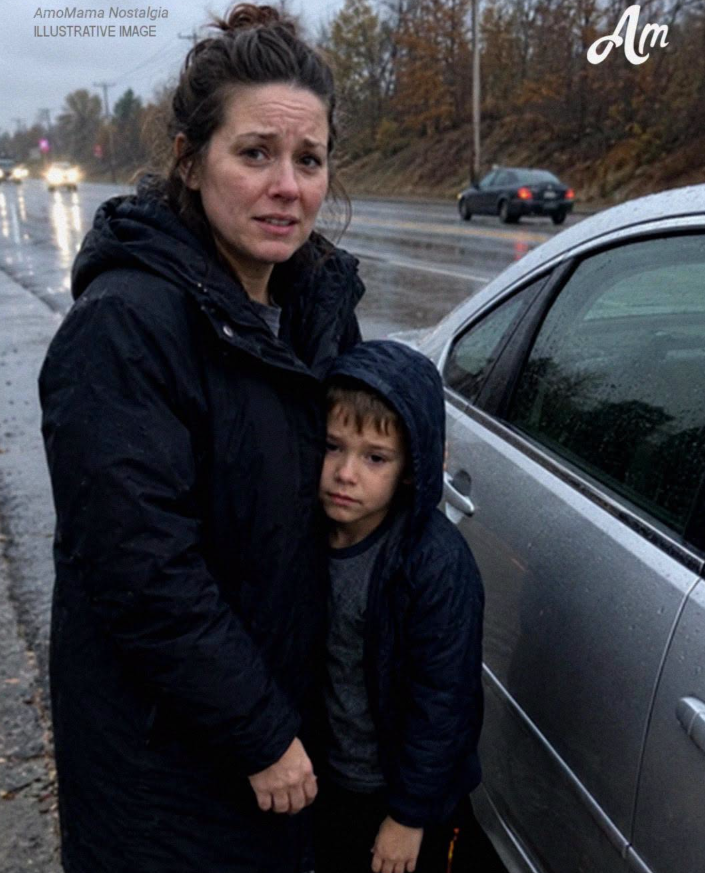
A woman and a small boy on the shoulder, both soaked through, stood beside a silver Honda with its hood half open.
The decision had already been made.
I pulled over before I’d fully decided to.
“Do you need a ride?” I called through the window.
“Are you sure?” the woman asked, shivering hard enough that her voice shook with it.
“I’m not leaving a kid out in this storm. Get in.”
She thanked me twice before she’d even gotten the door shut, and the boy climbed in behind her, small and silent and pressed close against her side.
“Do you need a ride?”
“I’m Jonathan,” I said. “What’s your name?”
“Mara,” she replied, buckling the boy in. “This is Owen. My son.”
“Where are you heading?”
“Ashford,” Mara answered. “My sister works at the diner there.”
“Engine just gave out?” I pressed.
“Smoked and stopped. I didn’t know what else to do.”
“What’s your name?”
***
She didn’t say much else the rest of the drive. Owen fell asleep against her arm somewhere around the second mile.
I dropped them outside the diner 20 minutes later, watching them hurry through the rain toward the door before I pulled back onto the road. I still had an important business to run.
The pawn shop clerk offered me $200 for a ring worth at least seven hundred.
“It was my wife’s,” I said, like that would change anything. “Now mine.”
He didn’t care.
“I don’t care who it belonged to, Sir,” he said. “Take it or leave it.”
I took it.
“It was my wife’s.”
I bought milk, bread, and the cheapest cereal on the shelf, and I drove home feeling like I’d buried Nancy all over again, this time somewhere between the dairy aisle and the checkout line.
***
“Dad? Did you get the milk?” Toby called from the porch as I pulled into the driveway.
He was sitting with Mrs. Enos, our kind, elderly neighbor, who had offered to keep him company until I got home. The moment she spotted my car, she gave me a warm wave and headed back toward her house.
“Got it, buddy,” I said, smiling. “Stay right there.”
I drove home feeling like I’d buried Nancy all over again.
I reached into the back seat for my coat, and that’s when my hand brushed against something small and spiral-bound.
A notebook. Mara’s.
I recognized it immediately from the photo of her and her son tucked beneath the clear plastic pocket on the front cover.
I almost set it aside to return later. Then I saw the words on the first page, written in handwriting that looked like it had been pressed too hard into the paper.
“If something happens to me…”
I recognized it immediately.
“Dad, what’s wrong? You look scared,” Toby asked, stepping closer.
I was scared.
“Go back inside, bud,” I said. “Right now.”
“Whose notebook is that?”
“Just go inside.”
***
I flipped the page and felt my hands go cold.
It wasn’t a journal entry at all—it was a plan.
“Dad, what’s wrong? You look scared.”
Owen’s allergies, an aunt’s phone number, instructions on who to call, what to say, and how to manage the things that mattered most if Mara wasn’t there to do it herself.
I called 911 before I’d even finished the second page.
“I need to report a woman in danger,” I said.
“Are you with her right now, sir?”
“No. I dropped her off about 20 minutes ago. I think she’s running out of time. There is a phone number mentioned.”
I called 911.
The dispatcher walked me through it patiently, and an officer called back 15 minutes later with the kind of correction that rearranges everything you thought you understood.
“Just spoke to her sister. She isn’t running from a person, Jonathan,” he said. “She was recently diagnosed with aggressive breast cancer. That notebook is her contingency plan.”
I stood in my living room, holding the phone a little too tightly.
“I need her address,” I said. “I have to return it.”
I left Toby with Mrs. Enos again and hurried back to my car.
“I need her address.”
***
Mara opened the door only a few inches when I knocked.
“What are you doing here?” she asked, her voice tight.
“The police told me you were safe. I brought your notebook back.”
She snatched it through the gap. “You had no right to read this.”
She was right.
“You left it in my car. I thought you were in trouble.”
“You had no right to read this.”
“I’m fine,” she said, already pulling the door shut, and I put my hand flat against it before it could close all the way.
“Mara, please.”
“Please what? Let you pity me?”
“I don’t pity you.”
Her voice finally cracked. “I’m sick. I have breast cancer.”
“The officer told me. He spoke to your sister.”
“I’m sick.”
“Then you know I don’t need a stranger’s charity,” she snapped.
“It’s not charity,” I insisted. “It’s just returning what’s yours.”
***
She stood there shaking in the doorway.
“I don’t know what happens to Owen if I don’t make it,” she muttered.
“I know.”
“How could you possibly know that?”
“It’s not charity.”
“Because my wife, Nancy, died two years ago. Cancer. I’m raising my son alone. I live that exact fear every single day.”
Something in Mara’s posture dropped all at once, like a wall coming down.
***
“I have nobody,” she said. “My sister is three hours away.”
“You have me.”
“You don’t even know me, Jonathan.”
“I have nobody.”
“I know what a parent looks like when they think they’re out of time,” I said. “I pawned my wedding ring today just to buy my son cereal. We’re both just trying to survive right now. Let me help.”
She finally stepped back and let me inside.
***
Over the following weeks, helping became a routine neither of us had to discuss out loud.
“I pawned my wedding ring today.”
I picked Owen up from school on the days Mara had appointments. I made dinner for both boys more nights than not.
Nothing dramatic. Just showing up in the small, unglamorous ways that don’t make for good stories but somehow hold an entire family together.
One evening, while Owen and Toby built something elaborate and collapsing out of couch cushions in the next room, Mara sat at my kitchen table looking more tired than I’d seen her yet, chemo having taken something out of her that the rest hadn’t given back.
I made dinner for both boys.
She noticed the photograph on the bookshelf. Nancy, laughing at something off camera, the picture I’d never quite found the strength to put away.
“Your wife was beautiful,” she said.
“Yeah. She always is.”
“You still talk about her in the present tense sometimes. Did you notice that?”
I laughed, just a small one. “I don’t always catch myself doing it.”
“Your wife was beautiful.”
She was quiet for a moment, turning her water glass slowly on the table.
“My doctor keeps talking about making plans for next year,” she said. “Some days I can’t even picture next month.”
I didn’t know what to say. So I said nothing.
“Did Nancy know?” she finally asked. “Before. That it might not work out.”
“She knew,” I said. “She just spent more time worrying about Toby than she ever spent worrying about herself.”
I didn’t know what to say.
Mara looked at me like she was seeing something she recognized from the inside, a fear with the same shape as her own, just further down the road.
***
Her surgery came a few weeks later, with complications that turned one night into three.
I had both boys for most of it. We ate too much cereal and watched movies we’d all seen before. And on the second night, I found Owen sitting very still on the edge of the guest bed, pretending to read a book he wasn’t actually reading.
Toby sat down next to him without saying much at first.
Her surgery came a few weeks later.
“You don’t have to pretend,” Toby said eventually. He understood.
Owen looked up.
“What?”
“That you’re not scared. I did that too. After my mom.”
Owen’s face did something complicated, somewhere between relief and the specific kind of recognition that only another kid who’s lived through it can offer.
“You don’t have to pretend.”
“I keep thinking she’s not going to wake up,” Owen whispered.
“I thought that every single night for like a year,” Toby muttered. “It’s okay to think it. It doesn’t mean it’s true.”
I stood in the hallway and didn’t go in.
***
Mara came home weaker, but steady, and the months that followed weren’t dramatic so much as quietly cumulative. There was treatment, then recovery, then ordinary Tuesdays that slowly stopped feeling like emergencies.
“I keep thinking she’s not going to wake up.”
One afternoon, with both boys at my kitchen table doing homework that mostly wasn’t getting done, Owen looked up at me out of nowhere.
“Why are you helping us?” he asked. “You don’t even know us.”
“Because somebody helped me once,” I said. “When I was completely lost.”
“Who?”
I looked over at the photo on the shelf.
“Why are you helping us?”
“Your mother?” Owen guessed.
I shook my head.
“My wife.”
He didn’t ask anything else after that. I think, in his own way, he understood exactly what I meant.
***
Three months later, Mara’s sister connected me with someone hiring for a logistics job two towns over. I got it within a week.
He understood exactly what I meant.
One evening, sitting on the porch steps with Toby and his ice cream, he asked the question I’d been waiting for, in the quiet way kids ask the biggest things.
“Do you still miss Mom every single day?”
“Every second.”
“Me too,” he whispered.
“I think that’s okay, buddy.”
“Do you still miss Mom every single day?”
He was quiet for a moment, working on his ice cream.
“Would Mom like Mara and Owen?”
I thought about Nancy then, really thought about her, about the time she’d once stood in the rain for 40 minutes helping a neighbor change a tire because she couldn’t stand the thought of someone struggling alone while she had two working hands.
“Yeah, champ. This is exactly the kind of thing your mother would’ve done.”
“Would Mom like Mara and Owen?”
I pulled him into a hug and looked out at the quiet street, feeling something close to peace for the first time in longer than I could measure.
Losing Nancy taught me how much grief takes away.
Helping Mara reminded me it doesn’t take everything.
Losing Nancy taught me how much grief takes away.