Emma had waited two weeks to relive her wedding day through the photographer’s lens. But one picture, taken that very morning, turned her happiest memory into the start of a question no one in her family wanted to answer.
Emma had spent ten years mourning her sister, Sophie.
Some grief aged quietly. It did not scream every morning or keep a person on the floor forever. It learned to sit at the breakfast table.
It rode in the passenger seat.
It waited in the mirror during birthdays, holidays, and ordinary Tuesdays when Emma caught a flash of blonde hair on the street and forgot how to breathe.
Sophie had died in a car accident when she was 23.
At least, that’s what everyone believed.
For years, Emma had replayed the phone call in her mind. Her mother’s broken sobs. Her father’s strained voice telling her not to come to the hospital because there was nothing she could do.
The silence afterward.
The funeral that felt less like goodbye and more like a cruel mistake no one knew how to fix.
Sophie had been the wild one. The one who sang too loudly in the car, borrowed Emma’s sweaters without asking, and left handwritten notes on the fridge just to make people laugh. Emma had been quieter, steadier, always the girl who remembered appointments and brought an extra cardigan.
After Sophie was gone, Emma became even quieter.
Then Nick came into her life.
He did not try to fix her grief.
He did not tell her it was time to move on or that Sophie would want her to be happy, though Emma knew both things were probably true. Instead, he listened.
He learned Sophie’s name not as a tragedy, but as a person. He asked about her favorite songs. He smiled when Emma told him how Sophie once dyed their dog’s tail pink with temporary hair spray.
Little by little, Emma started laughing without feeling guilty.
So when that morning arrived, the morning she married the love of her life during a beautiful garden ceremony, Emma had let herself believe that joy could stand beside loss without betraying it.
Everything was perfect, just as she had always dreamed.
The garden was filled with white roses, soft greenery, and rows of wooden chairs tied with satin ribbon. Sunlight fell over the aisle like a blessing. Her dress had a fitted bodice with lace sleeves and a skirt that moved like water when she walked.
Her mother cried before the ceremony even began, pressing a tissue under her eyes so she would not ruin her makeup.
“You look like a dream,” her mother whispered, cupping Emma’s face.
Emma smiled, but her throat tightened.
“I wish Sophie could see it.”
Her mother’s hands stiffened for only a second before she pulled Emma into a careful embrace. “She would have said your veil was too sensible.”
Emma laughed through the ache. “She would have tried to replace it with something dramatic.”
“Probably feathers,” her mother said, though her smile did not quite reach her eyes.
Her father stood near the door, polished and solemn in his suit. He had always carried grief differently from her mother. Where her mother cried in small, sudden bursts, her father went still.
He became all straight lines and quiet orders.
When it was time, he offered Emma his arm.
“Are you ready?” he asked.
She looked toward the garden, where Nick waited beneath the floral arch, nervous and handsome, twisting his wedding band before it was even on his finger.
“Yes,” Emma said softly. “I am.”
Her father nodded. “Then let’s go.”
As they walked down the aisle, Emma felt every eye on her, but she only saw Nick. His face changed when he saw her. His smile trembled, and for a second, he looked like he might cry.
“You’re staring,” she whispered when she reached him.
“I’m trying to memorize this,” he murmured.
The ceremony passed in a warm blur. Vows. Rings. Applause. Nick’s hands holding hers tightly, as if he had no plans to ever let go. When the officiant pronounced them husband and wife, he kissed her with such open joy that the guests cheered.
For the rest of the day, Emma felt carried by happiness. She danced with her father. She watched her mother laugh with Nick’s aunt. She posed for endless photos in the garden, by the fountain, and near the old stone wall where the ivy had grown thick and green.
Once, during the reception, Emma stepped away and touched the small charm tied inside her bouquet. It held a tiny photo of Sophie, smiling at 19 with windblown hair and mischief in her eyes.
“I miss you,” Emma whispered.
Nick found her there a moment later.
“You okay?” he asked gently.
Emma nodded. “I am. I just needed a second.”
He looked at the bouquet and understood. “She’d be proud of you.”
Emma leaned into him. “She’d be making fun of your dancing.”
Nick grinned. “Fair.”
Then came the honeymoon.
For two weeks, Emma let herself be someone light. She and Nick slept late, ate too much seafood, got sunburned on the second day, and took blurry photos by the ocean.
She missed Sophie, of course. She always did. But the grief felt softer there, folded into the sound of waves and Nick’s hand in hers.
Two weeks later, the newlyweds returned home. Their suitcases sat half-unpacked in the bedroom, and the house smelled faintly of laundry detergent and rain.
The photographer had just sent over the wedding photos.
That evening, after a shower, Emma settled onto the couch and began scrolling through the images.
Most of them were exactly what she expected. Nick laughing with his groomsmen. Her mother wiping tears. Her father walking her down the aisle. Emma glowing in a way she had never seen in herself before.
Then one photo caught her attention.
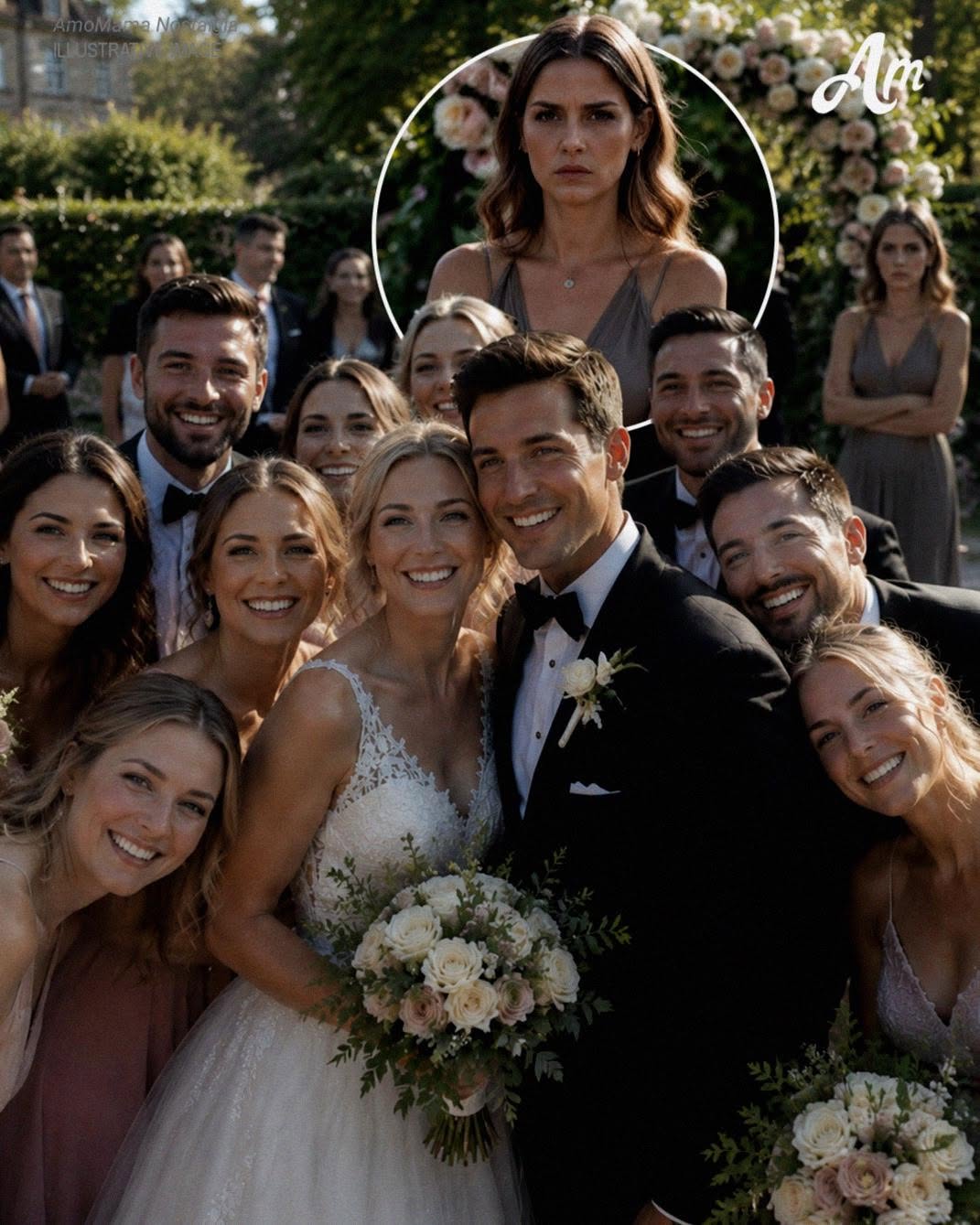
A woman was standing in the background.
Emma leaned closer.
The woman was near the old stone wall, partly hidden by guests and flowers. Her face was turned toward the camera, clear enough to see.
“Oh my God,” Emma whispered.
Then her heart stopped.
The woman looked exactly like Sophie. The same blonde hair. The same smile. The same tiny scar above her eyebrow.
“That’s impossible.”
Her fingers went cold around the tablet.
“Nick!” she called to her husband.
He appeared from the kitchen with a towel over one shoulder. “What is it? Don’t tell me you’re already criticizing the photos.”
“Look.”
Nick took the tablet from her hands.
A second later, he fell silent.
“Is this some kind of joke?”
“No.”
With trembling hands, Emma dialed her mother’s number.
“Mom, check your email.”
Silence.
“Mom?”
No answer.
And then she heard her father’s cold voice on the other end of the line.
“She survived after all.”
Emma did not remember grabbing her coat. She barely remembered Nick taking the keys from her shaking hands and guiding her to the car.
Her father’s words kept circling inside her skull.
By the time they reached her parents’ house, rain had begun to fall in thin silver lines. Emma ran up the porch steps with the tablet pressed to her chest like evidence, heavy as a wound.
Her mother opened the door before Emma could knock.
“Emma,” she breathed.
Emma pushed inside. “Who survived?”
Her mother’s face crumpled.
“Who was Dad talking about?”
Nick stepped in behind Emma, quiet but close.
Emma held up the photograph. “Mom, please. I need you to tell me what this means.”
Her mother covered her mouth and started crying.
Not softly. Not the kind of crying Emma had seen at funerals or weddings. This was deep, frightened grief, the kind that comes from a place buried for too long.
Her father stood in the hallway, his shoulders rigid. He stared at the image for a long moment.
Then he said quietly, “I hoped she’d never find you.”
Emma’s stomach dropped. “Who?”
Her mother sank onto the couch. “Her name is Grace.”
Emma stared at them. “I don’t know anyone named Grace.”
“No,” her father replied. “You wouldn’t.”
The room felt too small. Emma looked from her father to her mother, searching their faces for the family she thought she knew.
Her mother wiped her cheeks with trembling fingers. “Sophie had a twin sister. An identical twin.”
Emma’s knees weakened. Nick caught her elbow.
“That’s not possible,” Emma whispered. “I would have known.”
“We were young,” her mother said, her voice breaking. “We were scared. At birth, doctors discovered Grace had a severe congenital heart defect. They told us she had very little chance of survival. They said she most likely wouldn’t live more than a few months.”
Emma shook her head. “So you hid her?”
Her father’s jaw tightened. “We were advised to focus on the healthy child.”
“The healthy child,” Emma repeated, disgust rising in her throat. “You mean Sophie.”
Her mother sobbed harder. “We signed away our parental rights. I have hated myself every day since.”
“But she survived,” Nick said, his voice low.
Her father nodded once. “She underwent several surgeries. A year later, she was adopted by another family.”
Emma looked down at the photograph again.
The woman in the background was not Sophie’s ghost. She was Grace, standing alone at a wedding that should have welcomed her.
“Did she know?” Emma asked. “Did Grace know who you were?”
“No,” her mother whispered. “She was never told who her biological parents were.”
Emma left that house with more questions than air in her lungs.
It took three days to find Grace. The photographer had captured enough angles for Nick to trace her through a guest’s social media post. When Emma finally stood outside Grace’s small apartment, her hand hovered over the door for nearly a minute.
Grace opened it.
For one sharp second, Emma saw Sophie.
Then the differences appeared. Grace’s eyes were guarded. Her hair was shorter. Her smile, when it came, was nervous and sad.
“You’re Emma,” Grace said.
Emma nodded, tears already burning. “And you’re Grace.”
Grace stepped aside. “I didn’t mean to hurt you. I only wanted to see you.”
Inside, over untouched tea, Grace told her the rest.
Five years earlier, she had accidentally discovered she was adopted. From that moment on, she had searched for her biological family.
A few months before Emma’s wedding, she found a lead. She learned about Emma, about the ceremony, and about the family she had been denied.
“I couldn’t call,” Grace admitted. “What was I supposed to say? ‘Hi, I think your parents gave me away?'”
Emma reached across the table. “You should have been told. We all should have.”
Grace’s eyes filled. “Sophie knew.”
Emma froze.
Grace stood and took an old envelope from a drawer. Inside were dozens of letters written in handwriting Emma knew better than her own.
“Sophie found me a year before she died,” Grace said. “We wrote to each other. Then we met. She wanted to tell you.”
Emma touched one letter with shaking fingers. “Why didn’t she?”
“She was afraid.”
Grace brought out Sophie’s journals next. Emma read until the room blurred. In several entries, Sophie wrote that after discovering Grace, she had started digging into the family’s past.
At first, the entries were angry and heartbroken.
Then they became frightened.
No names. No clear accusations. Only fear pressed into ink.
Emma stopped at a page where Sophie’s handwriting had turned uneven.
Grace’s voice dropped. “That one.”
Emma swallowed and read aloud, “Someone called again. Same voice. Told me to stop.”
The room went painfully still.
Grace gripped the edge of the table. “Keep going.”
Emma looked back at the page, and the next sentence seemed to turn the air cold.
“I think the accident wasn’t an accident.”
A few days before the crash, Sophie had left Grace a package. “She told me to open it only if something happened to her,” Grace whispered. “I was too scared.”
Now, she gave it to Emma.
Inside were photographs, medical records, old letters, and one unopened envelope addressed personally to Emma.
Emma opened it with trembling hands.
“My dearest Emma,”
“I don’t know when you’ll read this, or why. I hope it is because I finally found the courage to put everything in front of you myself.”
“Finding Grace has been one of the happiest moments of my life. I know that sounds impossible, considering what her existence means and how much has been hidden from us, but it’s true. She is real. She is kind. She is our family.”
“I wanted to introduce her to you after your birthday. I wanted proof first. I wanted answers. Maybe I also wanted enough courage to face Mom and Dad without falling apart.”
“You deserved to know.”
“Grace deserved to be loved. And I’m so sorry I kept this from you, even for a little while.”
“If I don’t get the chance to explain it all myself, please don’t let the truth harden your heart against her. She didn’t choose any of this. Neither did we.”
“Promise me one thing, Emma. Don’t waste another day. Love Grace the way I wish I’d had more time to.”
“Your sister,”
“Sophie.”
Emma covered her mouth, but the sob escaped anyway. Grace stood frozen across from her, as if expecting rejection.
Instead, Emma crossed the room and pulled her into her arms.
Grace broke first. Then Emma did.
Neither of them could bring Sophie back. Neither could undo the lie that had shaped their lives. But in that small apartment, with Sophie’s words between them, Emma chose what her sister had asked of her.
She chose not to waste another day.
What would you have done if you were in Emma’s place? Would you welcome Grace after learning the truth, or would the years of lies make it impossible to trust your family again?
If you loved reading this story, here’s another one for you: A young boy forms an unexpected bond with his sick elderly neighbor, showing up for her when no one else seems to. Years after her passing, he discovers a mysterious box bearing his name, leading him to a truth that makes their quiet friendship even more meaningful.