My stepson disappeared from my life for 10 years. Then, on my 62nd birthday, somebody rang my doorbell and left a dead yellow rose on my doorstep.
The bell rang twice.
When I opened the door, the porch was empty.
Only that brittle rose lay on the mat, its petals curled in like old paper.
My knees went weak.
Stephen was five when I married his father.
For one awful second, I was not 62. I was 35 again, opening the door to a skinny boy with dirty hands and a flower behind his back.
Stephen was five when I married his father.
His mother had been gone more than a year by then. Not dead. Just gone, the kind of gone that leaves the furniture behind and takes the air with it.
The first week I moved in, Stephen stood in the hallway in mismatched socks and asked, “Are you staying?”
I said, “Do you want me to?”
He started calling me Mom by accident when he was six.
He gave me the smallest shrug I’d ever seen.
A week later, he nodded once and whispered, “Yeah. I think so.”
He started calling me Mom by accident when he was six.
He froze right after he said it, eyes wide, like he’d broken something precious.
I told him, “You can call me whatever feels right, honey.”
His little face pinched. “Did I hurt your feelings?”
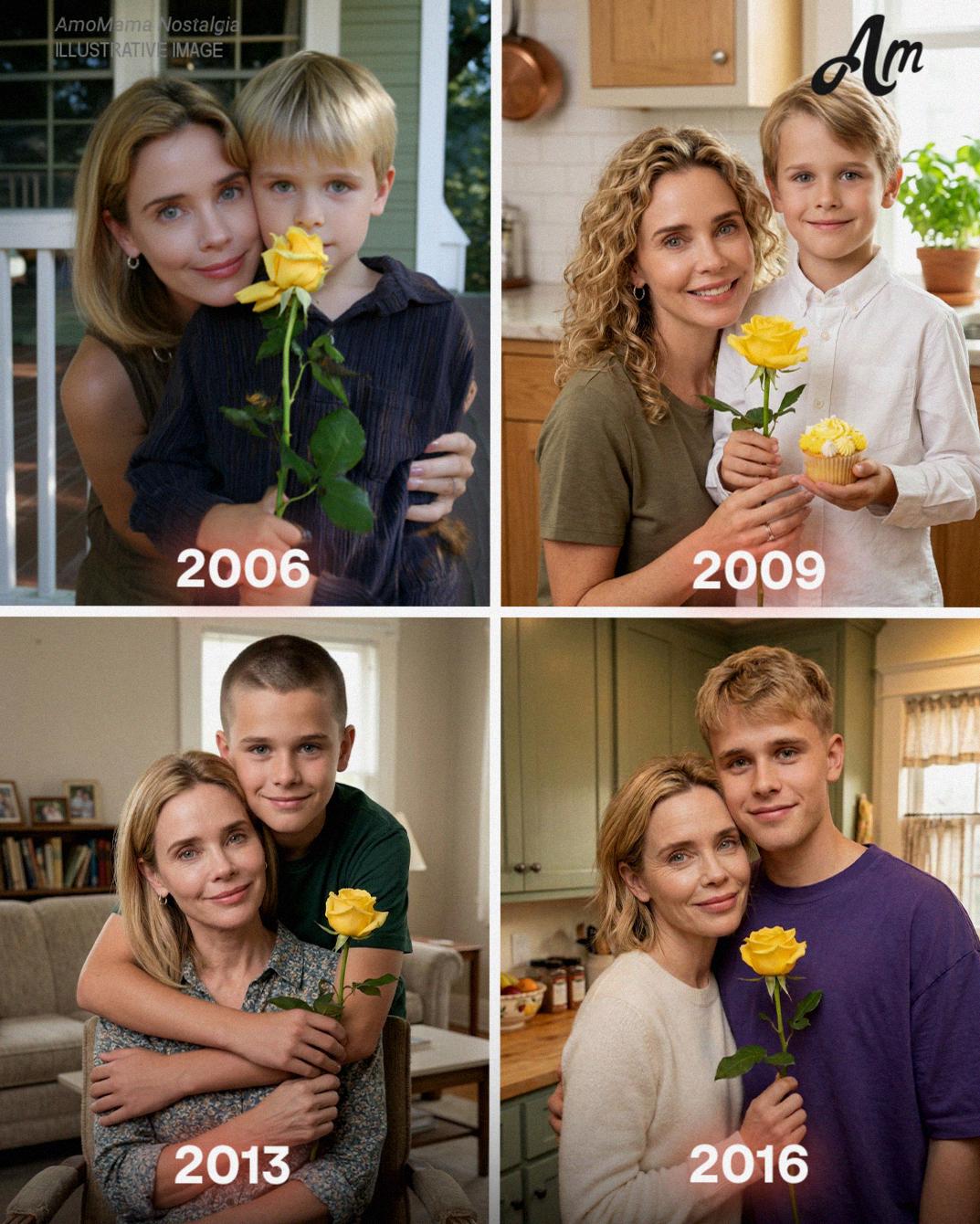
Every year on my birthday, he brought me a yellow rose.
I pulled him close and kissed the top of his head. “No, sweetheart. Not even a little.”
I raised him after that. Packed lunches. Signed slips. Sat through school concerts. Pressed cool washcloths to his forehead when fever had him burning up.
Every year on my birthday, he brought me a yellow rose.
The first one came from Mrs. Carter’s yard.
I put my hands on my hips and said, “Stephen James, did you steal that woman’s flower?”
At 16, he got a grocery job and bought one from a florist.
He lifted his chin, stubborn as a fence post. “I borrowed it.”
“Flowers are not library books.”
“It’s for your birthday,” he said, like that settled everything.
I tried to stay stern. “You still have to apologize.”
He sighed like a put-upon old man. “Can I apologize after you keep it?”
I kept it.
Then my husband died.
At 16, he got a grocery job and bought one from a florist. He grinned and said, “Mine are decent, but yours should be perfect.”
I waited for my birthday every year just to see his face at the door.
Then my husband died.
One Tuesday morning, he kissed my cheek, griped about weak coffee, and left for work. An hour later, there was an ambulance, a hospital room, and a doctor with kind eyes I still resent. Brain aneurysm, they said.
Stephen was 16.
He didn’t answer.
After the funeral, he changed by inches.
He started taking phone calls outside. If I walked into the kitchen, he went quiet.
If I asked how he was doing, he’d mutter, “Fine,” in that flat teenage voice that meant the opposite.
I told myself grief was making him strange.
Then, on his seventeenth birthday, I came home from work and found him packing a duffel bag.
I stood in the doorway and said, “What are you doing?”
His shoulders tightened.
He didn’t answer.
He shoved a sweatshirt into the bag and yanked the zipper closed.
“Stephen.”
His shoulders tightened.
“Talk to me.”
Without looking at me, he said, “I’m leaving.”
That was when he turned around.
I let out a laugh because I truly thought I had heard wrong. “Leaving where?”
“With my mother.”
The whole room went cold.
I said, very carefully, “Your mother?”
That was when he turned around.
His face looked too old for 17, all anger and hurt.
“She told me everything.”
“She found me months ago,” he said.
Months.
I grabbed the doorframe. “Months ago? And you didn’t say one word to me?”
He gave a bitter laugh. “Why would I? So you could spin me another story?”
I stared at him. “I have never lied to you.”
His eyes filled, but his voice got meaner. “She told me everything.”
“You wrecked our family.”
“Stephen, I don’t know what she told you, but—”
“You were Dad’s mistress.”
I flinched.
He kept going. “You wrecked our family. You pushed her out. You made him choose you.”
“That is not true.”
“She said you trapped him.”
That one hit so hard I had to cover my mouth.
“Stephen—”
“Stop saying my name as if you care.”
That one hit so hard I had to cover my mouth.
I tried again. “Your father and I met after she left. She knows that.”
He shook his head. “Of course, that’s what you’d say.”
“Sit down,” I pleaded. “Please. We can look at dates, papers, whatever you need.”
I stopped breathing.
He grabbed the duffel and pushed past me.
I followed him down the hall. “Don’t do this. Don’t walk out like this.”
Then he said the sentence that split my life in half.
“I only pretended for Dad. I didn’t want to disappoint him.”
I stopped breathing.
He opened the front door.
Ten years is long enough for doubt to grow roots.
Then he looked back and said, “I was never really your son.”
And he walked out.
After that, he vanished as completely as smoke.
His number changed. His social media disappeared. By the time I found the apartment his mother had rented, it was empty.
Ten years is long enough for doubt to grow roots.
So when I saw that dead yellow rose on my doorstep, my body knew it was him before my mind admitted it.
There was a small box beside the flower.
Tied around the stem was a note.
It said, I had to make you hate me.
My hands shook so badly that I nearly dropped it.
There was a small box beside the flower, one I hadn’t seen at first.
Inside was a pink-and-white hospital bracelet with a baby girl’s name printed on it.
My name.
Beneath the bracelet sat a brass key.
My exact name.
Under that was another note in Stephen’s handwriting.
You were the first home I ever had. I named my daughter after you. I know I don’t deserve that word, but she should know the woman who raised me.
Beneath the bracelet sat a brass key.
Under the key was a deed.
He thought he had finally found the truth.
A small cottage by the sea, two hours from my town, paid in full and transferred into my name.
There was a longer letter too.
Stephen wrote that after his father died, his biological mother came back crying, apologizing, and telling polished lies. She said she’d been kept away, that I broke up their family, that his father wanted her back.
He believed her.
For a while, he thought he had finally found the truth.
Then he found a letter from his father.
Then her stories shifted. Dates stopped matching. After she was evicted, he found court papers and letters proving she’d left long before I met his father, and that his father had tried to find her.
Then he found a letter from his father.
Stephen had enclosed a copy.
I read it three times before the words would sit still.
If anything happens to me before you’re grown, stay with your mom, his father wrote. Blood is not what made her your parent. Love did. She chose you every day.
He built a whole life around not turning back.
I broke all over again.
But by the time Stephen learned the truth, too much time had passed.
Shame, he wrote, had hardened around him. He built a whole life around not turning back.
He reminded me of a vacation when he was nine. We were walking by the water when I pointed at a little white cottage and laughed, “One day, when you’re rich, buy me a place like that.” He’d said, “I will.”
The last lines of his letter said, I built my business on anger at first. Then guilt. Then hope. The house key is yours. It always was. If you can bear to see me, come there tomorrow at noon. If you can’t forgive me, keep the cottage anyway. I promised you once.
For a moment, I didn’t know him.
I did not sleep that night.
The next morning, I drove to the coast with the dead yellow rose on the passenger seat beside me.
The cottage was exactly the sort I used to daydream about.
Small. White. Blue shutters. A porch facing the water.
Stephen was standing outside when I pulled up.
For a moment, I didn’t know him.
His voice cracked on the word.
He was broader now, bearded, with grief written in his face.
He took one step toward me, then stopped.
I got out of the car.
Neither of us spoke.
Then he said, “Hi, Mom.”
His voice cracked on the word.
He looked at it and started crying right there on the porch.
My chest tightened. “You do not get to start there.”
He nodded immediately. “You’re right. I know.”
I walked closer. “Why now?”
His hands shook. “Because my daughter was born six days ago, and when I held her, I thought if she ever looked at me the way I looked at you that day, it would kill me.”
He swallowed hard. “I kept picturing you on your birthdays. I kept thinking about every yellow rose I should’ve brought and didn’t.”
He laughed without humor.
I held up the dead one. “Why was it dead?”
He looked at it and started crying right there on the porch.
“Because that’s what I did to us,” he said. “I wanted to bring a fresh one. I almost did. But this felt honest.”
I asked, “Why didn’t you come back when you learned the truth?”
He laughed without humor. “Because every year made me more ashamed. Because I told myself showing up would tear you open again. Because I was a coward.”
He covered his mouth with one hand.
“Yes,” I said. “You were.”
He flinched like he agreed.
My own voice shook. “You destroyed me.”
His head dropped.
“Don’t nod,” I said. “You have a daughter now, but you do not know what it did to hear you say you were never my son.”
He covered his mouth with one hand.
I stared at him for a long time.
I kept going because ten years of pain had earned its turn.
“I questioned every memory. I saw boys with your haircut in stores and nearly ran after strangers. I hated my birthday. I hated yellow roses. I hated myself for still loving you.”
By then, he was openly sobbing.
“I am so sorry,” he said. “I know, sorry doesn’t fix one thing. But I am.”
I stared at him for a long time.
That did it.
Then I asked the question that had lived under my skin for a decade. “When you said you only pretended for him, was that true?”
His answer came fast, like he’d been waiting years for it.
“No. Not one bit of it. It was a lie. I loved you my whole life. I said the cruelest thing I could think of because I wanted leaving to feel final. I wanted you mad enough not to stop me.”
I closed my eyes.
That did it.
Three days later, he brought her to my house.
I sat on the porch step and cried, the kind of crying that leaves you emptied out. He crouched nearby and did not touch me.
After a while, he asked, “Do I still get to call you Mom?”
“Not for free.”
Inside, the cottage held a blue kettle, a yellow blanket, and a framed photo of his newborn. On the back: She deserves to know her grandmother.
This time, he stayed.
I pressed it to my chest. “You can call me Mom when you earn being my son again.”
Three days later, he brought her to my house. She wrapped her hand around my finger and held on tight.
On my next birthday, he came with his daughter and a fresh yellow rose.
“Happy birthday, Mom,” he said.
This time, he stayed.