Some mistakes follow you long after childhood ends, even when you’ve spent years trying to become a better person. I realized that the day my granddaughter came home from school with a note that felt painfully personal.
My name is Margaret. I am 59, and to be honest with you, I have a past that I am ashamed of.
You see, I wasn’t a good person in high school. That’s the truth, no matter how many years pass.
I wasn’t the kind of girl who got into screaming matches, caused scenes in hallways, or became violent. What I did was quieter than that. Meaner in ways adults rarely noticed until the damage was already done.
That’s the truth.
You know how cruel children can be.
- A whisper at the right moment.
- A laugh when someone walked by.
- A nickname that spread and stuck longer than it should have just because I said it first.
And the person I hurt most was a girl named Carol. I never forgot her.
For years, I told myself we were just kids and that everybody did stupid things.
I got older, married, raised my daughter Rachel, and built a life that looked respectable from the outside.
But guilt doesn’t disappear just because time passes.
I told myself we were just kids.
***
Sadly, three years ago, Rachel and her husband, Daniel, never made it home from a weekend trip. That one phone call about their car accident changed everything.
After that, my granddaughter became my whole world, Sophie. She had luckily stayed behind with me while her parents went away. I can’t imagine how I would’ve survived if she’d gone along.
My granddaughter was only nine when she moved into my house.
My granddaughter became my whole world.
She was a sweet kid, but shy and quiet, and she still slept with Rachel’s sweater tucked under her pillow every night because it smelled like her mother.
I promised myself I’d raise Sophie differently from how I’d behaved growing up. I wanted her to be kinder and better.
***
This year, my granddaughter started fifth grade.
At first, she liked her new teacher, Mrs. Harris. She talked about the plants near the classroom windows and the chapter books her teacher read after lunch.
Then, slowly, things changed, and her smile started to fade.
At first, she liked her new teacher.
***
Sophie’s spelling tests came home marked down for “messy handwriting,” even when the answers were correct. A science project, for which she spent an entire weekend making a poster, got a C because it supposedly “lacked effort.”
That one bothered me.
The thing is, I’d watched my granddaughter work for hours at the dining room table, cutting out planets and rewriting labels carefully so they’d look neat.
When I asked her about it, she shrugged.
That one bothered me.
“Mrs. Harris just doesn’t like me, Grandma,” Sophie said, looking sullen.
I told myself that she was probably being sensitive.
Then Friday came.
***
My neighbor dropped her off, and I heard her crying before she had fully opened the front door.
Not normal crying either. The kind where a child can barely breathe between sobs.
I rushed into the hallway.
I heard her crying.
“Sophie? What happened?!”
My granddaughter shoved her backpack toward me without answering. Inside was a folded note with one sentence written in blue ink.
“Bad behavior runs in families.”
My hands turned cold.
I read it twice, hoping I’d misunderstood somehow. But there was no misunderstanding.
That wasn’t a teacher correcting behavior. It was personal.
I looked down at the signature.
Mrs. Harris.
“Sophie? What happened?!”
Something about the name started bothering me immediately.
I walked into my bedroom, opened my laptop, and pulled up the school website. The faculty photos loaded slowly across the screen.
Then I saw Mrs. Harris and froze.
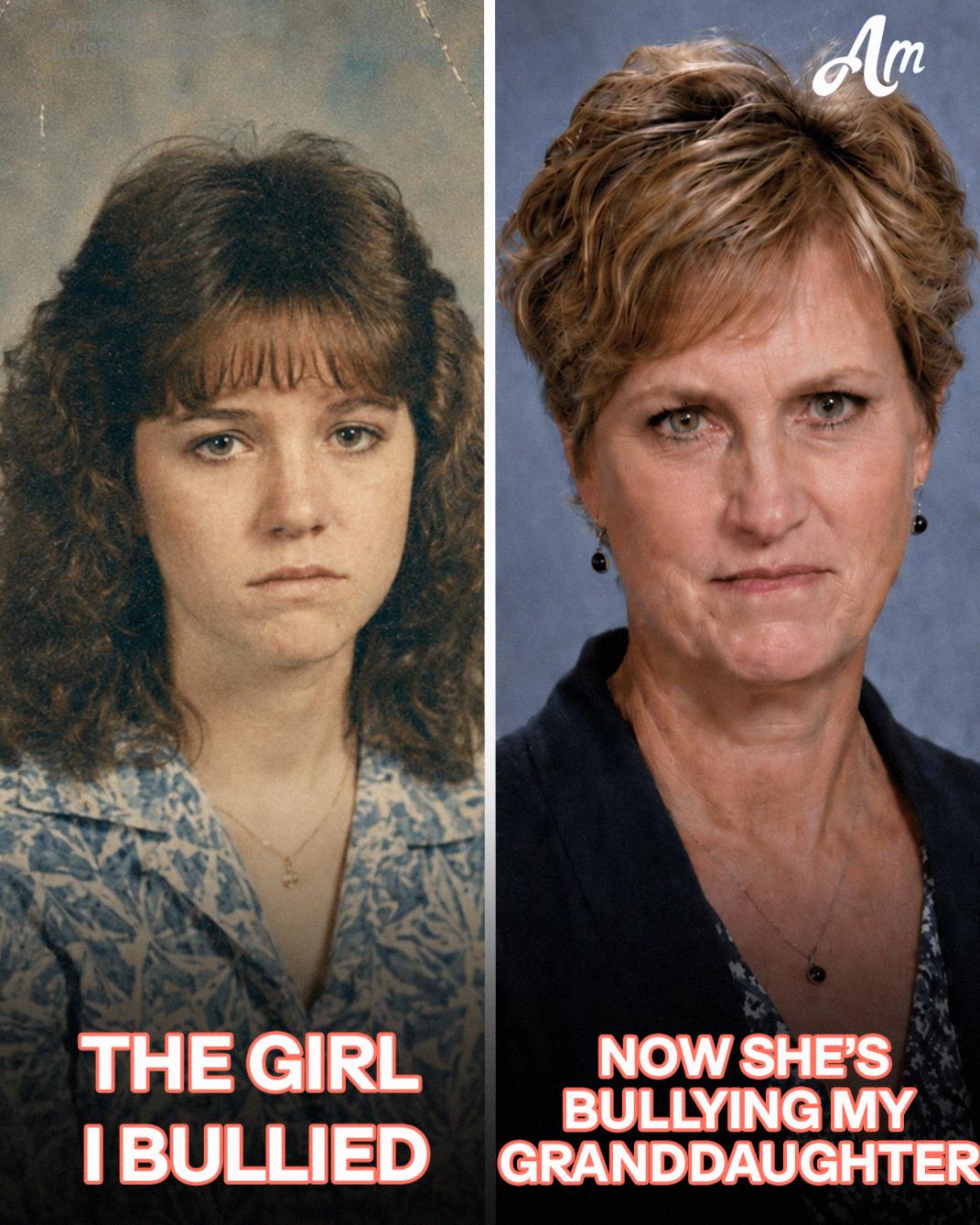
It was Carol. Yes, that same Carol from my past!
But she was older now. Short brown hair instead of the long braid she wore in high school. Fine lines around her eyes. But the same unmistakable tight smile.
And now she was teaching my granddaughter!
But she was older now.
I sat there staring at her photo while Sophie cried quietly in the living room.
Carol knew exactly who my granddaughter was. Which meant she also knew who I was.
And somehow, after over 40 years, the past had found its way back to me.
***
Although I managed to calm Sophie down, that night I barely slept.
Every time I closed my eyes, I remembered things I’d spent years trying not to think about.
Which meant she also knew who I was.
- Carol sitting alone during lunch, pretending to read.
- How she went quiet whenever I entered a room.
- Also, the way other kids followed my lead because making people laugh made me feel important back then.
Around midnight, I checked on Sophie.
She was asleep, curled around Rachel’s sweater.
And anger hit me all over again.
Whatever history existed between Carol and me had nothing to do with my granddaughter.
I decided to act because I wasn’t going to let a little girl pay for my sins.
Anger hit me all over again.
***
That morning, I called the school and arranged a meeting with Principal Bennett and Mrs. Harris.
Sophie and I walked into the school office together. Carol was already there.
I was still shocked to see her after all these years, and the second she saw me, her entire expression tightened.
Like an old wound reopening.
Principal Bennett stepped out of his office and motioned us inside.
“I understand there’s concern regarding a classroom note,” he said carefully.
I handed him the paper silently.
His face tightened immediately after reading it.
I called the school.
Carol crossed her arms.
“You’re acting like context doesn’t matter,” she said quietly.
Principal Bennett frowned slightly. “Context?”
My granddaughter’s teacher looked directly at me.
“You know exactly what context.”
Beside me, Sophie shifted nervously in her chair.
I gently touched her shoulder.
“Sweetheart, why don’t you wait outside with Mrs. Greene for a few minutes?” Mrs. Greene was the secretary.
My granddaughter nodded uncertainly and left.
“You know exactly what context.”
The second the office door closed, Carol let out a shaky breath.
“You made my life miserable in high school!”
There it was. And the worst part was, she wasn’t wrong.
“I know,” I said quietly.
Carol looked surprised for half a second.
“You don’t even remember half of it,” she replied.
Then everything started pouring out.
The worst part was, she wasn’t wrong.
Carol mentioned the whispers, rumors, jokes loud enough for entire classrooms to hear, and the birthday party I convinced people not to invite her to.
Things I’d forgotten completely that she still remembered word for word.
“I used to sit in my mom’s car before school, trying to work up the nerve to walk inside,” Carol admitted softly.
That hurt me because suddenly I could picture it perfectly.
A little girl outside the school every morning, trying not to fall apart before first period.
And I’d helped create that feeling.
Carol mentioned the whispers.
Principal Bennett leaned forward carefully.
“Mrs. Harris, whatever happened years ago, it doesn’t excuse directing comments toward a student.”
Carol looked down.
“I know.”
For the first time since we sat down, she looked less angry and more exhausted.
“When Sophie walked into my classroom,” she admitted quietly, “she looked exactly like your daughter. And Rachel looked exactly like you.”
My chest tightened instantly.
She looked less angry and more exhausted.
Carol looked toward me before continuing.
“I tried to stay professional. I really did. But every time Sophie smiled at me or raised her hand, it felt like I was a kid again.”
The principal folded his hands together.
“That still doesn’t justify treating a student unfairly.”
Carol nodded immediately.
After a long silence, Bennett sighed.
“I’m giving you a formal verbal warning. And if personal history ever starts affecting your classroom decisions again, you come directly to administration before it reaches this point.”
“I tried to stay professional.”
Carol swallowed hard and nodded once.
“I understand.”
The meeting ended awkwardly after that.
I expected Carol to leave angrily. Instead, she looked embarrassed. Ashamed, maybe.
And suddenly my own guilt felt unbearable.
Because yes, Carol had been wrong to take her feelings out on Sophie.
But I had planted those feelings there decades earlier.
The meeting ended awkwardly after that.
***
Over the next two weeks, things improved.
With Sophie’s grades back to fair, the homework hour lost its tension.
***
One afternoon while we baked cookies together, Sophie smiled and said, “Mrs. Harris liked my presentation today.”
I smiled back, but inside, something uncomfortable settled deeper.
Because instead of relief, I mostly felt shame.
Over the next two weeks, things improved.
***
A few nights later, after my granddaughter went to bed, I pulled an old yearbook from the hallway shelf.
There I was, smiling in group photos as if I owned the world.
And there was Carol.
Always near the edge of the frame. Half-hidden, trying not to be noticed.
I also stared at a chemistry class photo for a long time.
Then I closed the book and made a decision.
I pulled an old yearbook.
***
The following morning, I called Principal Bennett.
“Do you have a school assembly this week?” I asked.
“Yes…”
“I’d like to speak at it.”
Silence.
Then cautiously, “About what?”
“About consequences,” I answered quietly.
After I explained everything, he finally agreed.
Friday morning came too fast.
“I’d like to speak at it.”
***
When Sophie and I walked into the school gym, rows of folding chairs were already filling with students while teachers stood near the walls, talking quietly.
My granddaughter looked up at me nervously.
“Grandma, why are you here?”
“You’ll see,” I said softly.
Across the gym, I spotted Carol standing near the back wall.
The second she saw me, confusion crossed her face.
“Grandma, why are you here?”
A few minutes later, Bennett stepped onto the stage and adjusted the microphone.
“Today,” he said carefully, “someone asked to speak to all of you about kindness, accountability, and how our actions affect other people.”
Then he looked directly at me.
“Margaret?”
A nervous ripple moved through the gym as I stood.
Every step toward that stage felt heavier. When I reached the microphone, my hands shook so badly that I had to grip the stand.
“Someone asked to speak to all of you.”
For one terrible second, I almost lost my nerve.
Then I looked out at all those children sitting in rows. And all I could think was how easily cruelty starts in places exactly like this.
“Hello, everyone. My name is Margaret. And when I was in school, I wasn’t a kind person.”
The gym fell completely silent.
“I wasn’t loud about it. But I laughed at people, left people out, and said things that made other kids feel smaller because it made me feel important.”
Near the back wall, Carol stared at me in shock.
I almost lost my nerve.
“There was one person in particular I treated terribly,” I continued. “And for years, I convinced myself it didn’t matter because we were young.”
I swallowed hard.
“But children grow up. And sometimes they carry pain much longer than we realize.”
Everyone remained attentive.
“Every action has consequences,” I said softly. “The things we say to people don’t disappear just because time passes. Sometimes one careless moment becomes something another person carries for years.”
Carol covered her mouth with one hand.
“I convinced myself it didn’t matter.”
I turned fully toward her.
“Carol,” I said into the microphone, my voice shaking now, “I am deeply sorry for the way I treated you. You deserved kindness, and I gave you the opposite.”
Carol’s eyes filled instantly. Then tears started spilling down her face.
And before anyone else could react, Sophie suddenly stood up from her chair.
The entire gym watched as my granddaughter quietly crossed the floor toward her teacher.
Carol looked stunned as Sophie wrapped her arms gently around her waist.
“It’s okay,” she whispered.
That nearly broke me right there on stage.
“You deserved kindness.”
Because somehow, the smallest person in the room understood compassion better than the adults did.
Several teachers wiped tears from their eyes.
And Carol dropped to her knees, hugging Sophie tightly while crying into her shoulder.
***
After the assembly ended and everyone cleared out, Carol and I stayed behind in the empty gym.
For a moment, neither of us spoke.
Then Carol laughed weakly through tears.
Several teachers wiped tears from their eyes.
“I can’t believe you just did that in front of the whole school.”
“Honestly,” I admitted, “neither can I.”
That made her laugh again.
I looked at her carefully.
“I can’t undo what I did to you,” I said softly. “I know that.”
Carol nodded slowly.
“But maybe we can stop letting it hurt people.”
She looked down for a moment before meeting my eyes again.
There was a long silence.
“I can’t undo what I did to you.”
Then I asked quietly, “Do you think we could start over?”
Carol wiped at her eyes and gave a small nod.
“I’d like that.”
And standing there in an empty school gym, decades after all the damage first began, we finally started trying to heal something both of us had carried for far too long.