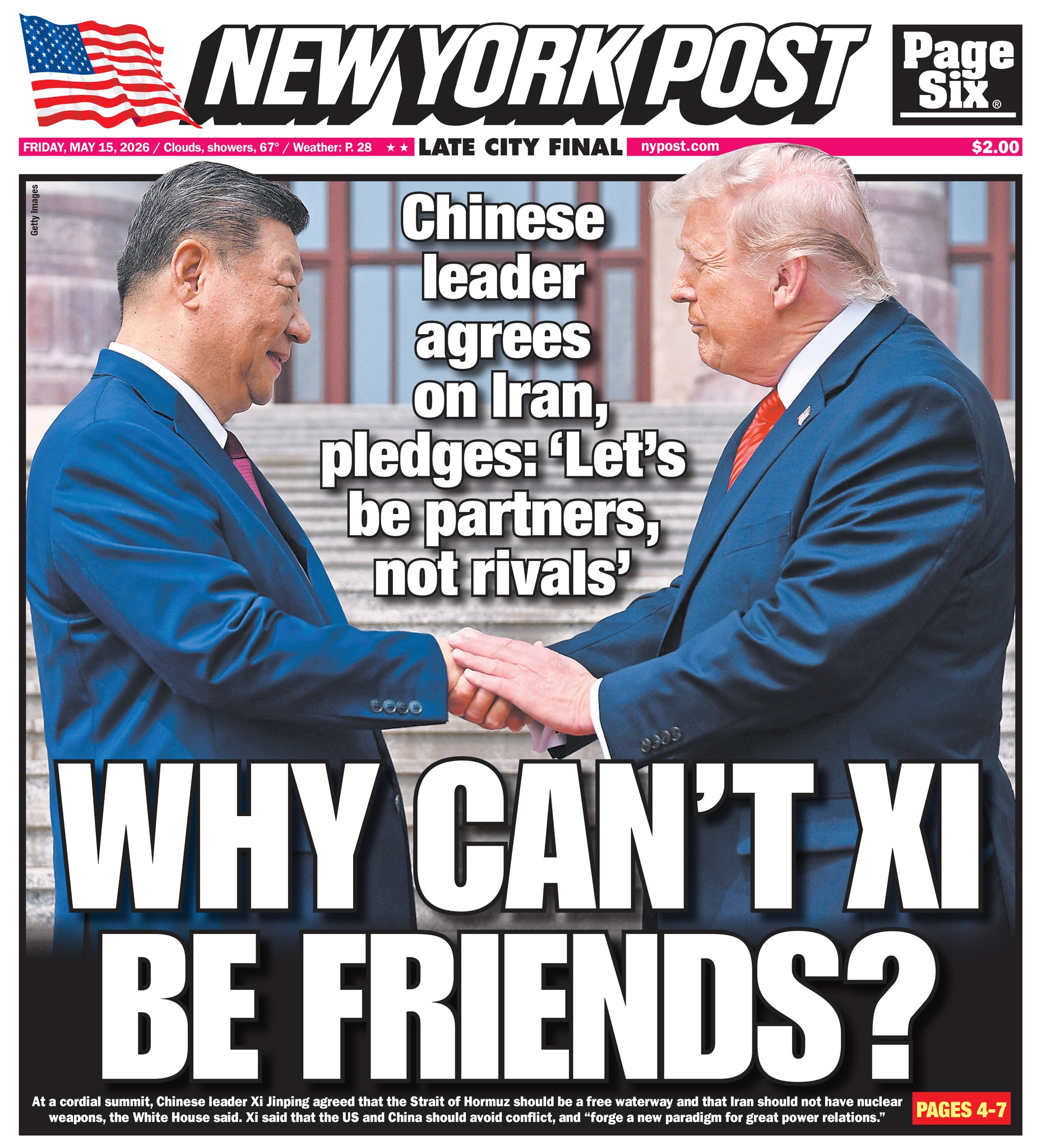
BEIJING — Chinese strongman Xi Jinping appeared to embrace President Trump’s stance on Iran Thursday, agreeing the fanatical regime should open up the Strait of Hormuz and never have access to a nuclear weapon – while pledging not to send arms to the Islamic Republic.
The striking display of alignment came with an offer from Xi, who intends to continue purchasing oil from Tehran, to assist the US in the region.
“President Xi would like to see a deal made, he would, he would like to see a deal made. And he did offer. He said, ‘If I can be of any help at all, I would like to be of help,’” Trump told Fox News’ Sean Hannity.

“Anybody that buys that much oil has obviously got some kind of a relationship with him,” Trump added. “He’d like to see the Hormuz Strait open. He said, ‘If I could be of any help whatsoever, I would like to help.’”
About a fifth of the world’s seaborne oil supply flows through the strait annually, and China has historically imported the lion’s share of the petroleum transited via the waterway, which has effectively been shut down due to the war.
An estimated 45% to 50% of China’s crude oil imports flow through the Strait of Hormuz. By contrast, only about 2% of America’s oil comes through the strait, according to the US Energy Information Administration.
“Our two countries should be partners rather than rivals,” Xi said at a state dinner with Trump.


While not referring to China specifically, Secretary of State Marco Rubio argued “countries around the world” that are “paying a much higher price” for oil than the US have “got to get involved” in pressuring Iran to open up the strait.
Rubio, in an interview with “NBC Nightly News,” further noted that Trump “didn’t ask [Xi] for anything,” related to Iran.
“We’re not asking for China’s help. We don’t need their help,” the top US diplomat said.
Prior to Trump’s visit to Beijing, the US president had raised concerns that China could be helping Iran restock its weapons, citing the American interception of a vessel heading toward Iran that “had some things on it, which wasn’t very nice — a gift from China perhaps, I don’t know.”

A spokesperson for the Chinese government denied those accusations.
There have also been concerns about China and Russia feeding Iran critical intelligence to help Tehran target US assets in the Middle East.
However, during a bilateral meeting that lasted more than two hours, Xi promised Trump he wouldn’t provide Iran with any military firepower, according to the president.
“He [Xi] said he’s not going to give military equipment, that’s a big statement,” Trump told Hannity. “He said that today, that’s a big statement. He said that strongly but at the same time he said, you know, they buy a lot of their oil there and they’d like to keep doing that.”
“He didn’t like the fact that they are charging tolls [in the strait]. I don’t know if they are or not. I don’t know who would pay them,” the president continued. “Where would they put the money? The country is decimated, where does the money go?”

A White House readout of the summit, held at Beijing’s imposing Great Hall of the People, also noted Xi “made clear China’s opposition to the militarization of the Strait” and “expressed interest in purchasing more American oil to reduce China’s dependence” on Iran.
“Both countries agreed that Iran can never have a nuclear weapon,” the readout continued.
Trump has long asserted that Iran must give up its stockpile of enriched uranium, as well as its nuclear ambitions, as part of any agreement to settle the war.
The common ground on Iran came after Xi opened the historic summit by questioning whether the US and China can “overcome the Thucydides trap and create a new paradigm of major country relations.”
He was referring to a concept that severe risks arise when an emerging power challenges a stronger, more established global authority. The term was coined by Harvard professor Graham Allison and named after ancient Greek historian Thucydides, who wrote that the rise of Athens put Sparta in such a defensive posture that war was inevitable.

Xi has referred to the Thucydides trap since at least 2014 regarding the US.
The Chinese leader, in his opening remarks at the summit, described the issues facing the US and China as “questions vital to history” but expressed a hope the two nations could “meet global challenges together and provide more stability for the world.”
“We must make it work, and never mess it up,” Xi said of US-China relations during his toast at a state banquet honoring Trump.
Xi expressed optimism that “achieving the great rejuvenation of the Chinese nation and making America great again can go hand in hand,” in reference to Trump’s MAGA slogan.
Trump is the first US president to set foot on Chinese soil since making the same trip in 2017. The two superpower leaders touched on a range of pressing issues, including trade, fentanyl, and the status of Taiwan.
“A lot of things,” Trump told Hannity when asked what Xi wants from the summit. “We talked about a lot of things, too many things to discuss, but a lot of things. We had a very good meeting, but we want things from them.”
“One thing he agreed to today, he’s going to order 200 jets. That’s a big thing — Boeings.”